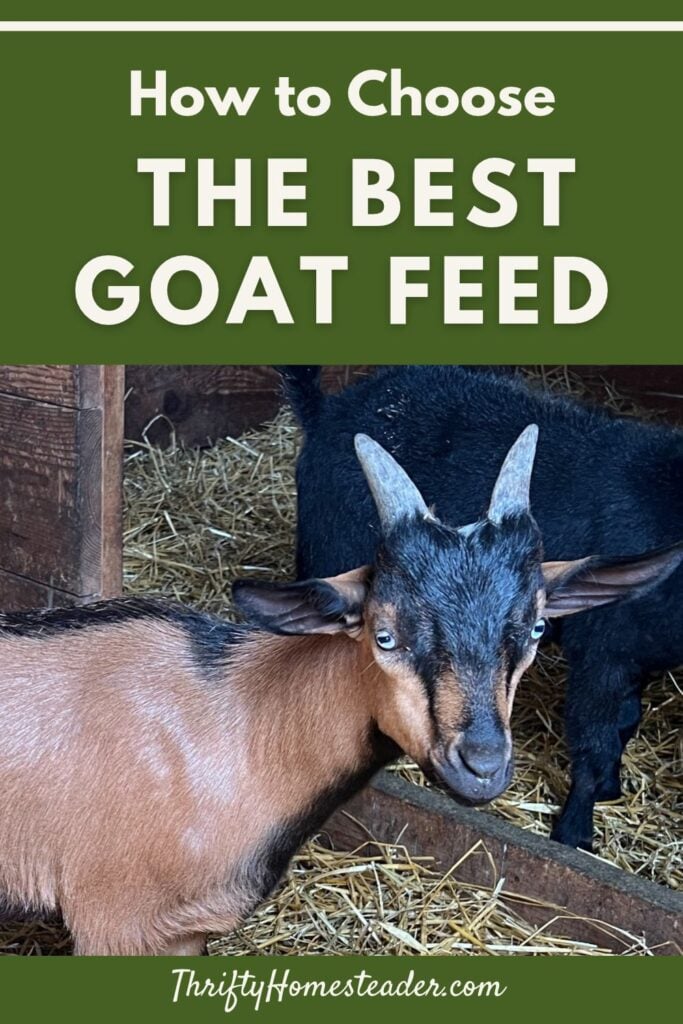
Not all goats need commercial goat feed, and not all feeds labeled for goats provide the nutrition they need. Before buying a bag of feed, you need to understand which goats actually need it and how to read the guaranteed analysis on the label.
One of the most common mistakes new goat owners make is assuming that all goats need grain every day. They see bags of goat feed at the farm store, hear other goat owners talking about their feeding routines, and assume they should be feeding their goats the same way.
But feeding goats properly isn’t about giving every goat the same diet. It’s about understanding their nutritional needs based on their age, production, and body condition.
And when a goat does need supplemental feed, choosing the right product matters.
Which goats actually need commercial goat feed?
There are three main groups of goats that benefit from a commercial goat feed:
- Growing kids need additional protein, calcium, and energy to support growth, especially during their first several months of life when they are growing fast.
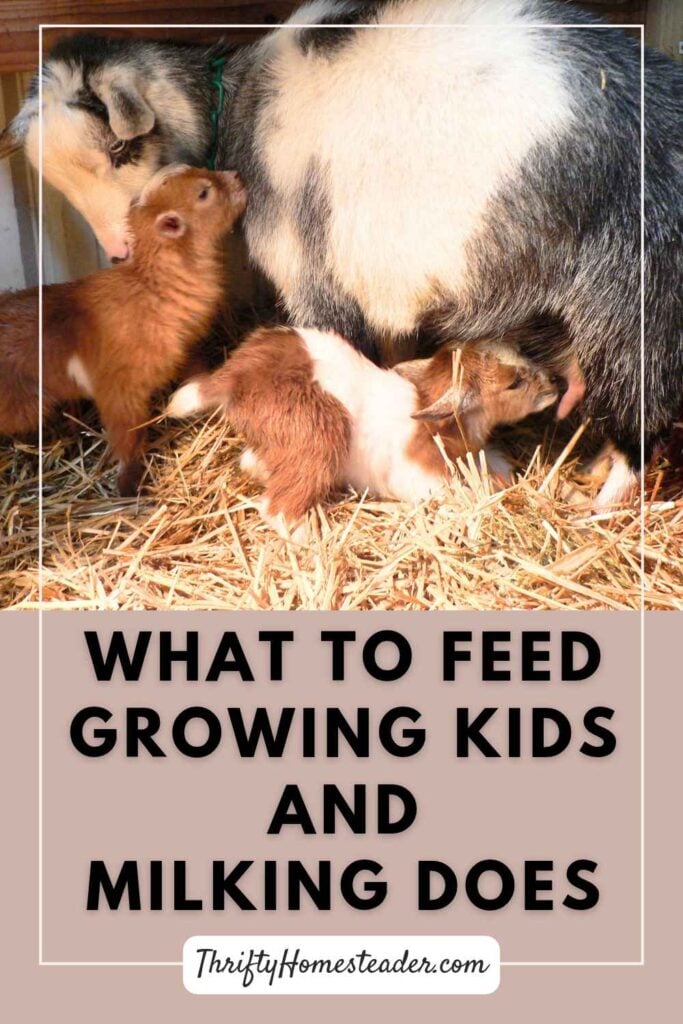
- Does in milk need additional nutrition to support milk production. The more milk they produce, the more nutrients they require. Without enough nutrition, they won’t produce up to their genetic potential.
- Goats recovering from significant weight loss may need supplemental protein and energy to regain body condition. This includes goats that have lost weight because of a heavy parasite burden or another health problem.
Most healthy, mature goats that are not producing milk can maintain good body condition on appropriate forage, such as pasture, browse, and good-quality hay, along with free-choice loose goat minerals.
That includes dry does, bucks, and wethers.
As I explain in What Do Goats Eat? It Depends!, there is no single feeding program that is appropriate for every goat.
Do bucks and wethers need goat feed?
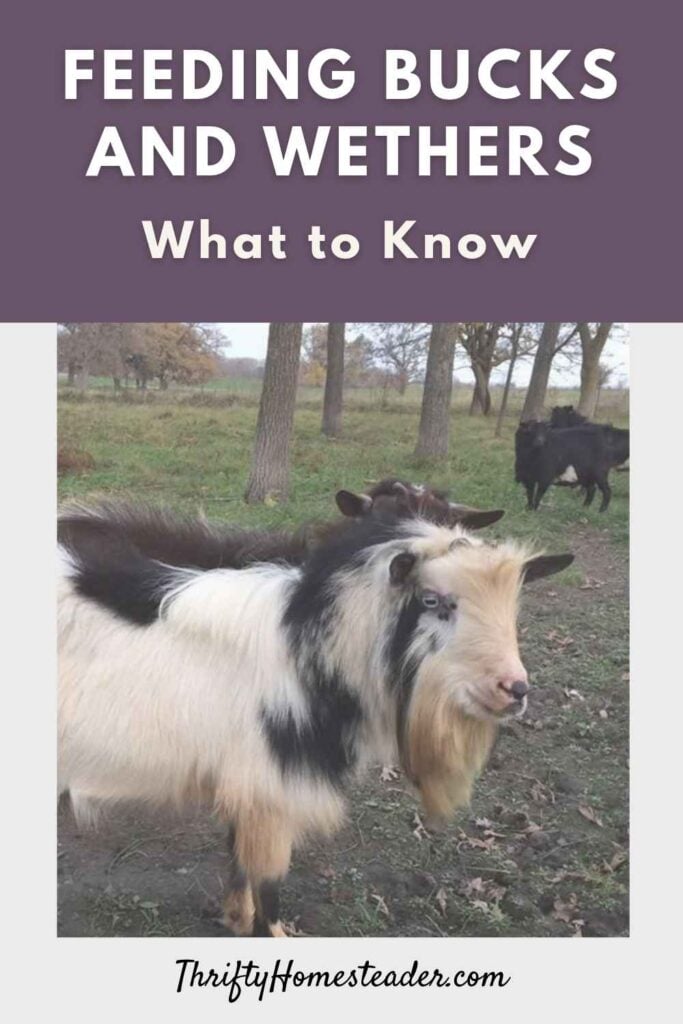
Healthy adult bucks and wethers should not need commercial goat feed.
In fact, feeding them grain and alfalfa unnecessarily can increase their risk of urinary calculi, a potentially fatal condition in which mineral stones form in the urinary tract and can block the flow of urine. Wethers are especially vulnerable because their urethra is narrow.
However, there are exceptions. Bucks sometimes lose considerable weight during breeding season because they spend more time chasing does, fighting with other bucks, and breeding than they do eating. A buck that has lost significant body condition may benefit from commercial goat feed temporarily.
Similarly, a buck or wether recovering from a heavy parasite burden may need additional protein to rebuild lost muscle.
But if an adult buck or wether is underweight on a forage-based diet, you need to find out why.
Is the hay poor quality? Is the goat dealing with parasites? Does it have dental problems? Is another goat preventing it from eating enough? Could there be an underlying illness, such as Johnes?
Simply adding goat feed to the diet without identifying the problem may temporarily improve body condition while allowing the underlying issue to continue. If parasites are responsible for the weight loss, for example, feeding additional protein will not eliminate the parasites.
You can learn more about feeding male goats in my article on preventing urinary calculi.
What do I mean by commercial goat feed?
When I recommend feeding grain to goats, I’m talking about a commercial goat feed containing approximately 16% protein with a balanced calcium-to-phosphorus ratio of 2:1.
I’m not talking about corn, oats, barley, or a mixture of those grains. Some people refer to a mixture of corn, oats, and barley as COB. Others mix their own grain combinations based on recipes they find online. The problem is that individual cereal grains are relatively low in protein and high in phosphorus compared with calcium.
Corn, oats, and barley contain only about half as much protein as a properly formulated 16% goat feed. They also have calcium-to-phosphorus ratios that are the opposite of what we want for goats.
For example, corn may contain 10 to 15 times as much phosphorus as calcium. This is particularly concerning for male goats because excess phosphorus can contribute to the formation of struvite urinary stones. People talk about adding alfalfa to the diet to balance the ratio, but adding alfalfa to a male goat’s diet sets the up for calcium stones, which are just as deadly as struvite stones. Feeding alfalfa to male goats is also the #1 cause of zinc deficiency in goats because the calcium binds with the zinc, making it unavailable for the goat to absorb.
Commercial goat feeds are formulated to provide a more appropriate balance of nutrients. That doesn’t mean every bag labeled “goat feed” is a good choice. You still need to check the label.
Why I don’t recommend homemade grain mixtures
I frequently see people on Facebook recommending homemade grain mixtures because they’ve been feeding them for years and their goats are supposedly doing fine.
But what does “doing fine” actually mean?
You don’t know what that person’s goals are. You don’t know how healthy their goats are. And you don’t know what they consider normal or acceptable.
For example, I’ve encountered multiple people whose standard-sized dairy goats were producing less milk than my Nigerian Dwarfs. One woman even wanted to buy some of my Nigerians because they were producing more milk than her standard-sized goats! She apparently thought her goats’ production was normal for their genetics, so she was looking for better genetics.
I always ask potential buyers about their feeding program, and when I learned what she was feeding, I explained all of this to her and told her that she would be very disappointed if she bought my goats and fed them what she’s feeding her goats. I suggested that rather than buying my goats, she simply improve the nutrition for the goats she already had — which would also help with the parasites problems that she thought were “normal” for goats! (There are multiple studies that show how a low protein diet decreases parasite resilience in goats.)
If someone is feeding an Alpine doe a homemade grain mixture and she’s producing only as much milk as a Nigerian Dwarf, that isn’t evidence that the feeding program is working well. The goat may be surviving, but she may not be getting the nutrition she needs to reach her genetic potential for milk production. This is why I don’t recommend choosing a feeding program based solely on someone’s personal experience. A properly formulated goat feed provides a nutritional foundation that a random mixture of grains does not.
How to read a goat feed label
Before buying any commercial goat feed, find the guaranteed analysis. Don’t assume that a product contains the nutrients your goats need simply because it has a picture of a goat on the bag.
There are four most important numbers I look for when choosing goat feed:
| Nutrient | What I look for |
|---|---|
| Crude protein | 16% |
| Calcium-to-phosphorus ratio | Approximately 2:1 |
| Copper | 35–40 ppm |
| Selenium | 0.5 ppm |
Why do these numbers matter?
Protein: 16%
Protein is essential for growth, milk production, and maintaining muscle. Growing kids need adequate protein to develop properly, and lactating does need additional protein to produce milk.
When I recommend a 16% goat feed, I’m referring to a feed with a guaranteed minimum crude protein content of 16%. For lactating does, a common starting point is approximately one pound of 16% goat feed for every three pounds of milk produced.
That number is a starting point, and the amount needed can vary from one doe to another. Each doe’s body has different priorities, which is based upon genetics. Some will get fat on that amount of goat feed while other will get skinny while producing huge quantities of milk. If a doe is losing weight, gradually increase the goat feed. If she is getting fat, you can decrease it.
For more information, read What to Feed a Nursing Doe, where I talk about how to know how much a nursing doe is producing to feed her kids, which gives you an idea of how much goat feed she need.
Remember: A bag of plain corn or oats won’t provide nearly enough protein for a doe to produce enough milk, maintain her body condition, and have a strong immune system.
Calcium and phosphorus: 2:1
Calcium and phosphorus work together in the body, and their balance is especially important. Ideally, a commercial goat feed should contain approximately twice as much calcium as phosphorus.
For example, if a feed contains 0.5% phosphorus, I would look for approximately 1% calcium.
When reading the guaranteed analysis, remember that calcium is often listed as a minimum and maximum, while phosphorus is listed as a minimum. These figures may not reveal the exact ratio in the finished feed.
An inappropriate calcium-to-phosphorus balance can contribute to urinary calculi, especially in bucks and wethers.
However, maintaining a 2:1 ratio does not guarantee that urinary stones cannot develop because phosphorus only causes struvite stones, and there are other types of stones.
Copper: 35–40 ppm
Copper is an essential trace mineral for goats. It plays important roles in reproduction, immune function, and overall health.
I look for approximately 35–40 parts per million (ppm) of copper in commercial goat feed. Most goat feeds have about half this much.
Copper deficiency can be a problem in goats because they can’t get enough from forage alone. However, by providing a goat mineral with at least 1700 ppm copper, most copper deficiency can be avoided. Does in milk need more copper, which is why you also need to have copper in the goat feed.
Copper deficiency can also be caused by other minerals in the diet and water, including sulfur and molybdenum.
Please, do NOT ever give your goats copper boluses (copper oxide wire particles) without knowing that you have a copper deficiency problem because you CAN kill a goat with COWP if they don’t need the extra copper.
You can learn more in my article on copper deficiency in goats.
Selenium: 0.5 ppm
Selenium is another essential trace mineral important for reproduction, muscle function, and immune health.
I prefer commercial goat feeds containing selenium close to 0.5 ppm. Some feeds contain only 0.3 ppm or less, which may not provide as much selenium as goats need when the feed makes up only part of their diet. I know these numbers are small, but 0.3 is almost half of 0.5, so it really matters!
However, more is not always better. Excessive selenium intake can cause toxicity, and selenium levels in forage vary geographically. The goal is to provide an appropriate amount from the entire diet, not simply to maximize the selenium concentration in one product.
For a more detailed discussion, listen to my interview with veterinary nutritionist Dr. Robert Van Saun about selenium deficiency and toxicity in goats.
Why does goat feed contain less copper and selenium than goat minerals?
If you’ve read my recommendations for choosing goat minerals, you may have noticed that the copper and selenium levels I recommend in commercial goat feed are dramatically lower than those in loose goat minerals.
For example, I look for approximately 1,700 ppm copper and 50 ppm selenium in a good loose goat mineral.
Why would I recommend only 35–40 ppm copper and 0.5 ppm selenium in goat feed?
Because goats consume very different amounts of these products.
A goat may consume only 0.25–0.5 ounce of loose minerals per day, depending on the product and the goat’s size.
On the other hand, a goat that needs commercial feed may consume one to three pounds of it daily, depending on its size, milk production, and nutritional requirements.
That’s an enormous difference in consumption. The concentration of a nutrient in a product tells you only part of the story. You also need to consider how much of that product the goat consumes.
This is why you should never compare the copper or selenium concentration in goat feed directly with the concentration in loose minerals and conclude that the feed is inadequate.
And remember that commercial goat feed does not replace free-choice loose goat minerals.
Medicated versus non-medicated goat feed
When shopping for goat feed, you may notice that some products are labeled “medicated.”
Medicated goat feeds contain a coccidiostat, which helps prevent coccidiosis.
Coccidiosis is caused by microscopic parasites called coccidia. It is primarily a concern in young kids, particularly during stressful periods such as weaning or moving to a new farm. A medicated feed may be useful for kids during these high-risk periods. Coccidiosis is the most common cause of diarrhea among kids between 3 weeks and 5 months of age.
However, there are several things to understand before purchasing one.
First, medicated feed is intended to help prevent coccidiosis, not treat an existing clinical infection. A kid showing signs of coccidiosis may need treatment regardless of whether it has been eating medicated feed.
Second, the medication is included at a concentration designed for a particular feeding rate, so you must follow the instructions on the bag to be sure the kid is getting enough medication. If you’re mixing medicated feed with other grains or feeding much less than the recommended amount, the kid may not consume enough medication for it to be effective.
Third, adult goats do not need it, and not every kid needs medicated feed. Healthy kids raised under good management conditions may do perfectly well on non-medicated feed. Medicated feed is not a substitute for good sanitation, appropriate stocking density, and careful observation of growing kids.
This is why I advocate weighing kids every day for the first two weeks to make sure no one is falling behind, especially in the case of triplets or more. The number one reason I see for coccidiosis is when someone leaves too many kids on a doe, and one of those kids doesn’t get enough milk and falls behind in weight gain.
Medicated feed should never be given to goats producing milk for human consumption because the medication will be in the milk. In fact, the labels tell you that it is not to be fed to goats producing milk for human consumption. However, I have seen lots of people feeding this to their milkers.
How much goat feed should you give?
The amount of commercial feed a goat needs depends on its age, size, production, forage quality, and body condition.
Growing kids may benefit from supplemental feed until they reach approximately half their expected adult weight.
Lactating does need feed based on their milk production and nutritional requirements.
Goats recovering from significant weight loss may need supplemental feed temporarily while the underlying problem is addressed.
Regardless of the reason for feeding it, introduce commercial goat feed gradually. Sudden increases in concentrated feed can disrupt the rumen and cause digestive problems, including acidosis and diarrhea.
And remember that commercial goat feed should supplement an appropriate forage-based diet, not replace it.
The bottom line: Choose feed based on your goat’s needs
Before buying goat feed, ask yourself two questions.
- Does this goat actually need commercial feed?
- And if so, does this product provide the nutrients it needs?
For most healthy adult goats that aren’t producing milk, good-quality forage and appropriate loose minerals are sufficient.
For growing kids, lactating does, and goats recovering from significant weight loss, a properly formulated commercial feed can provide valuable additional nutrition.
Look for approximately 16% protein, a 2:1 calcium-to-phosphorus ratio, 35–40 ppm copper, and selenium close to 0.5 ppm.
Don’t assume a homemade mixture of corn, oats, and barley provides equivalent nutrition. And don’t base your feeding program solely on what someone on Facebook says works for their goats.
The goal isn’t simply to keep your goats alive.
It’s to give them the nutrition they need to grow, produce, reproduce, and remain healthy throughout their lives.
Pin for later!