
One of the most common questions I hear during kidding season is:
“How much grain does a doe need when she’s nursing her kids?”
The quick answer is, “1 pound of 16% goat feed for every 3 pounds of milk she’s producing,” and the follow-up is always:
“But how do I know how much milk she’s making?”
The good news is that you don’t need to guess—and you don’t need to measure milk production to feed a nursing doe correctly. You can figure out exactly what she needs by looking at her kids.
Let’s walk through it step by step.
Online Course
Just Kidding & Raising Kids
Guide to Pregnancy, Kidding, and Newborn Care
Learn what’s normal, when to step in, and how to confidently care for your goats through pregnancy, birth, and the first weeks of life.
Enroll in the CourseThe Basic Rule for Feeding a Milking Doe
The standard recommendation for a lactating goat is:
- 1 pound of 16% protein goat feed for every 3 pounds of milk produced
- When we say “grain,” we mean a 16% protein goat feed — not plain corn, oats, or barley.
- Plus alfalfa hay
- at least 50% alfalfa, but 100% is even better
- Free-choice hay and pasture, available at all times
Hay and pasture should never be restricted. A doe making milk needs constant access to forage, which is hay or pasture. Grain is simply added to support milk production by increasing protein — it doesn’t replace forage. (Free-feeding grain could cause all kinds of rumen problems, such as bloat, which could be fatal.)
If a doe is nursing her kids, you can feed her goat feed when the kids nurse, usually morning and evening. First-time fresheners often do best being brought onto the milk stand once a day so they learn that the stand equals food and handling. That little bit of training makes life much easier later on.
“But I Don’t Know How Much Milk She’s Producing”
This is where people get stuck—but it’s actually pretty simple.
Instead of measuring milk, you base your calculations on the kids’ weight, because healthy kids tell you exactly how much milk they’re getting.
For kids to thrive, they need 20% of their body weight in milk every day.
Let’s use easy numbers.
Example: Twins Born at 5 Pounds Each
- Two kids × 5 pounds = 10 pounds of kids
- One pound = 16 ounces
- 10 pounds × 16 = 160 ounces total body weight
Now we calculate milk needs:
- 20% of 160 ounces = 32 ounces of milk per day
That equals 2 pounds of milk per day.
Now we go back to the feeding rule:
- 1 pound of 16% feed per 3 pounds of milk
- 2 pounds of milk ÷ 3 = ⅔ pound of goat feed per day
So on the day those kids are born, mom needs about ⅔ pound of 16% protein goat feed, plus free-choice alfalfa hay.
A Quick (But Important) Note About Grain
When I say grain, I am always talking about a commercial 16% protein goat feed.
Corn, oats, and other straight grains are not appropriate for a lactating doe:
- Corn: ~6–7% protein
- Oats: ~8–9% protein
Milk is high in protein. A doe cannot make good milk without adequate protein intake. Alfalfa helps, but it does not replace the need for a balanced goat feed when a doe is nursing.
Why This Changes Quickly: Kids Grow Fast
Here’s where a lot of people underfeed does without realizing it.
Kids grow rapidly—especially when they’re getting enough milk.
In my herd of Nigerian Dwarfs, I want to see kids gain about 4 ounces per day. That level of growth tells me they’re:
- Getting enough protein and calcium
- Building strong immune systems
- Far less likely to struggle with coccidiosis or parasites
I can’t even tell you the last time I had to deworm a kid—it’s been many years. And in the last decade, I’ve only had three coccidiosis cases in several hundred kids. Nutrition is a huge reason why.
There is extensive research showing that high-protein diets improve resistance to parasites, and milk is the most efficient way for kids to consume that nutrition. They simply cannot eat enough solid food to match what they get from milk.
What Happens by Two Weeks of Age
By about two weeks old, healthy Nigerian dwaf kids typically double their birth weight.
That means:
- Milk intake doubles
- And mom’s feed needs must double too
This is why I don’t assume a doe can successfully raise more than three kids if I want all of them to thrive. Yes, a doe might keep four alive—but at least one usually falls behind, fails to hit weight benchmarks, and often ends up with coccidiosis.
I didn’t always know this. We started weighing kids consistently about 12–13 years ago, and the data made everything clear. Growth rates don’t lie.
Tired of goat misinformation online?
Get clear, research-based answers and practical guidance inside Goats 365.
Join Goats 365Peak Milk Intake for Nigerian Dwarf Kids
Nigerian Dwarf kids usually peak at about:
- 1 quart (32 ounces) of milk per kid per day
- This typically happens around 3–4 weeks of age
Once they reach that point, intake levels off.
So if your doe has twins, that’s roughly 4 pounds of milk per day, which means she’ll need about 1⅓ pounds of 16% goat feed, plus free-choice alfalfa and forage.
How to Increase Grain Safely
If a doe hasn’t been getting grain:
- Start with ⅓ pound on day one
- Increase to ⅔ pound on day two
- Gradually increase as kids grow
By two weeks postpartum, most does will need about twice what they required at birth, depending on kid growth and litter size.
You can keep doing the math—or you can increase gradually while watching kid weight gain. Either approach works as long as you’re monitoring growth.
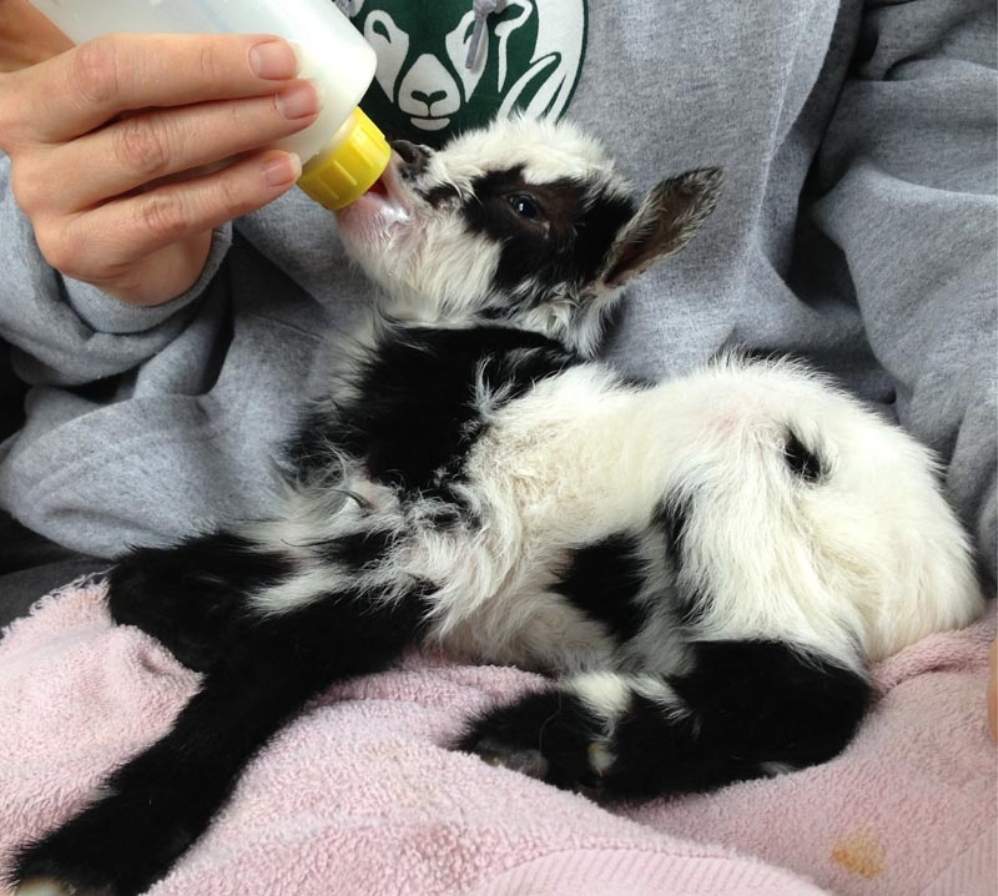
Why Bottle Babies Taught Us This
We learned a lot of this from bottle-raised kids.
Years ago, people commonly limited Nigerian Dwarf kids to 20–24 ounces per day. Looking back, that explains why coccidiosis was so common. Once we started feeding up to a full quart per day—when that amount equaled 20% of body weight—everything changed.
Health improved dramatically. Growth improved. Parasite problems nearly disappeared.
The Takeaway
If you want healthy kids and a thriving doe:
- Feed 16% protein goat feed, not straight grains
- Offer free-choice alfalfa and forage
- Base feed amounts on kid weight and growth
- Increase grain as milk demand increases
Your kids will tell you if you’re doing it right—especially when you put them on a scale.
For more information on calculating your herd’s total forage needs, you can also check out our guide on how much a goat eats per day.
🎓 Want a deeper dive into kidding and early kid care?
🎥 Watch the original video here:

If you have questions, feel free to ask in the comments. Kidding season is busy—but it doesn’t have to be confusing.
Pin for later!


Hi.
I can’t find alfalfa hay around me currently. How much alfalfa pellets should I offer does? Doe 1 has a 4.5 lb buckling, 4 days old.
Doe 2 has 3 kids, totaling 10 lbs, 3 days old.
Thanks
Hi Jill
You can offer alfalfa pellets at about 2% of the doe’s body weight in addition to her hay and her feed.
That would be 2# daily for a 100# doe. Adjust according to her body condition 🙂
~Tammy
What is the type/brand of grain for nursing does?
Thank you
Hi Julie!
A good choice for nursing does is a 16% protein, goat specific feed. Ideally it would have at least 30ppm copper and 0.5ppm selenium 🙂
There are quite a few to choose from. It just depends what is available in your area.
Tammy
One of my goats gains weight very easily and is putting on a lot of weight when I feed her this much grain, to the point that she is looking pregnant again. Her kids are 6 weeks old and growing well. Should I reduce the amount of grain the dam gets so she doesn’t gain too much weight? If so, how do I figure out the best amount of grain to feed her?
Hi Andrea
This is a recommendation to maintain good body condition for lactating does, but you should adjust up or down as needed by the individual goat 🙂
Be sure to assess anything else in her diet that could be contributing to weight gain, like high calorie treats. Those should be eliminated first and then adjust from there.
What breed is she, what type of feed is she getting, and how much?
Tammy
She is an Oberhasli. At the 4 week point after kidding, she was getting a mix of 1/2 lb of 14% feed from a local feed store and 1 lb of 17% feed (Nutrena Country Feeds). She was also getting ~1.25 lbs of alfalfa pellets/day and free choice hay and pasture. That’s about the time she started getting very wide again, so I backed off some on the grain feed but continued with the same amount of alfalfa. The only treats she gets are a few (2-4) animal crackers each day.
She had kidded a few times before we got her, but this is the first time she has raised her own kids. They’re doing great and growing like crazy. I just want to make sure we’re giving her the nutrition she needs without letting her weight get out of control.
Hi Andrea
Hmm… that certainly isn’t an enormous amount of feed for a standard sized dairy goat producing enough milk for kids that are growing well.
Body condition is always a great indicator of what adjustments need to be made, especially when we have an over-conditioned doe. It could be that she is really good at feed conversion and another thought would be the actual quality of what is growing out in your pastures 🙂 There may be some really nutrient dense forage that she is indulging in.
I would keep a close eye on the kids weight gain if you want to wean back on her feed. As twins I would expect them to be somewhere around the 25# mark at 6wks of age, and to continue gaining at ~6-8oz a day if mom is producing plenty of milk.
Perhaps start with reducing her grain concentrate by about 1/4 and see what that does over the next couple of weeks. I would not adjust alfalfa since that is providing both protein and calcium.
I’m actually dealing with some over-conditioned does myself right now, but they are in year 2 of lactation and far away from the energy requirements of a 6 week fresh doe.
Tammy
Thanks!
The person we got her from joked that she historically would gain weight just by smelling feed, so maybe you’re right about very efficient feed conversion. Our hay is coming from our own land, which the previous farmer used as a dairy farm until a few years ago and has been consistently maintained for over a decade, so the nutrient quality of the hay may be pretty high, just not alfalfa. The goats’ current forage area wasn’t ever used for agricultural purposes, so I’m not sure what quality it is.
We were continually tweaking her intake to manage her body condition last summer/fall while she was in milk. Her doeling is currently 30 lbs, her buckling is 37 lbs. I’ll adjust the grain and keep an eye on their weights.
Hi Andrea
Oh yes, those babies are getting plenty of milk! 🙂
Sounds like you have a great plan in place and I’m so glad that you are on top of over-conditioning. A lot of people brush it off as no big deal, but it really can lead to some health concerns~ especially with our girls.
Best of luck
Tammy