
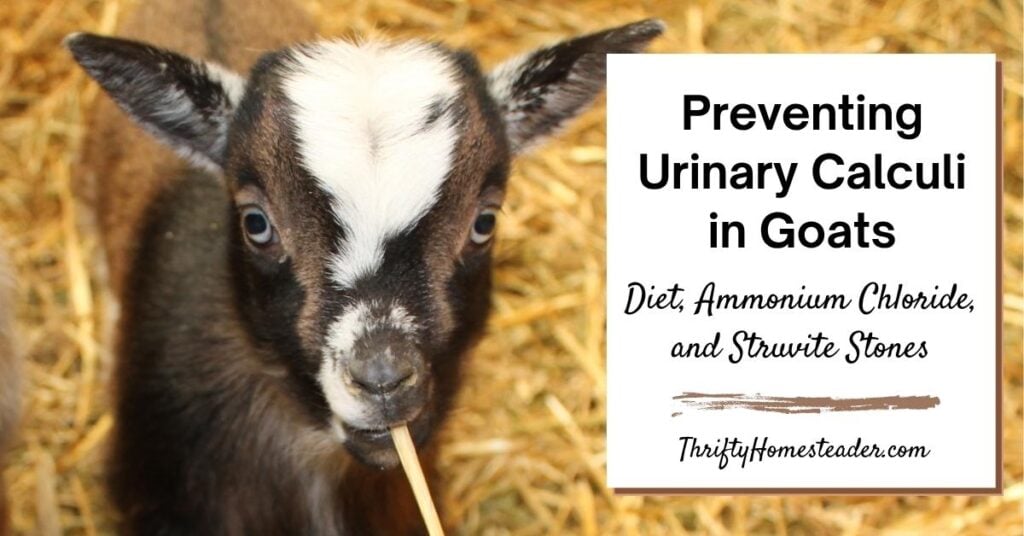
Urinary calculi—commonly referred to as “urinary stones” or “urolithiasis”—can be a painful and potentially fatal condition for goats, especially males. This issue is most commonly seen in wethers (castrated males) but can also affect intact bucks and, very rarely, does.
Understanding what causes urinary stones—and how to prevent them—is critical for anyone raising goats. In this article, we’ll explore the research behind urinary calculi, struvite stones in particular, and offer science-backed, practical steps to help you keep your goats healthy.
What Is Urinary Calculi?
Urinary calculi are solid mineral deposits that form in the urinary tract. These stones can block the urethra, preventing the goat from urinating. If not treated quickly, the bladder can rupture, leading to a painful death.
Goats have a particularly long and narrow urethra, and in wethers, it may be even narrower due to early castration stopping the full development of the urinary tract. This makes them more susceptible to blockages if stones form.
Why Are Wethers Most at Risk?
Urinary calculi (also known as “urinary stones” or “urolithiasis”) are a common and potentially life-threatening problem in male goats, especially wethers and bucks fed high-grain or high-calcium diets.
Struvite stones, formed from magnesium ammonium phosphate, are among the most common types. Preventing these stones is far easier than treating them, and recent research has provided new insights into the most effective prevention strategies.
Tired of goat misinformation online?
Get clear, research-based answers and practical guidance inside Goats 365.
Join Goats 365What Causes Struvite Stones in Goats?
1. Dietary Imbalance: Calcium to Phosphorus Ratio
The culprit that causes struvite stones is a diet with too much phosphorus and not enough calcium. Research in small ruminant nutrition consistently points to an ideal calcium-to-phosphorus (Ca:P) ratio of 2:1 as essential to prevent stone formation — so that’s twice as much calcium as phosphorus.
Here are the Ca:P ratios of common grains:
- Corn: ~1:10 to 1:15
- Oats: ~1:4 to 1:5
- Barley: ~1:6 to 1:8
All are high in phosphorus and low in calcium, which is the opposite of what goats should have — and they are much higher in phosphorus. Feeding any of these grains without balancing with calcium will put goats at risk of urinary stones.
This is one reason to feed a commercial goat feed when necessary, such as during breeding season when bucks may start to lose weight. Commercial goat feeds are usually balanced with twice as much calcium as phosphorus, but be sure to check the guaranteed analysis on the feed tag to be safe.
2. Low Water Intake
Dehydration concentrates minerals in the urine, increasing the risk of crystal and stone formation. Research shows that goats provided with ample clean water have a much lower incidence of urinary calculi.
3. Feeding Too Much Calcium
Calcium carbonate stones can form when a goat consumes too much calcium, which is present in alfalfa. While pregnant does and milkers need a diet high in calcium, bucks and wethers do not. When they consume too much calcium, they can wind up with calcium stones, so be careful about adding alfalfa to a buck’s or wether’s diet.
Many people use the word “grain” interchangably with goat feed and assume they always need to feed alfalfa when they feed “grain,” but unlike simply corn, oats, and barley, most goat feeds are already balanced with calcium, so adding alfalfa increases the calcium beyond that 2 to 1 ratio that’s required, which means that you could be causing calcium stones when you think you’re preventing struvite stones.
4. Alkaline Urine pH
Urine pH plays a role in the types of stones that form. Struvite stones tend to form in alkaline urine. Acidifying the urine through dietary means can help prevent struvite stones. Unfortunately, an old myth is that vinegar can acidify the urine and prevent stones, but this is not true. Ammonium chloride is the most common way to acidify urine, but it’s not as simple as buying a feed with added ammonium chloride.
Does Early Castration Cause Urinary Calculi?
In a word — no. Castration has nothing to do with the formation of stones. However, castrating bucks too early may prevent full development of the urethra, which means a smaller stone is more likely to cause a blockage when the urethra is smaller.
What the Research Says About Castration Timing
Studies show that testosterone plays a role in the growth and diameter of the urethra. Castrating bucklings too early—especially before 8 weeks of age—slows down the development, resulting in a smaller, narrower urethra that is more prone to blockage.
Research and veterinary consensus suggest that waiting until 10 to 12 weeks of age allows more time for urethral and penile development, lowering the risk of obstruction. This is especially important in smaller breeds like Nigerian Dwarfs and Pygmies, who are already anatomically at greater risk.
Goat care doesn’t have to feel overwhelming.
Join Goats 365 for courses, community, and expert guidance to help you raise healthier goats with confidence.
Join Goats 365What Does the Research Say About Ammonium Chloride?
Ammonium chloride (NH₄Cl) is widely used to acidify urine, making it less likely for struvite stones to form. However, not all dosing regimens are equally effective.
Key findings from recent studies:
- Low-dose ammonium chloride in feed (0.007%) is not effective. Research shows that this commonly used level does not lower urine pH enough to prevent stones.
- Continuous dosing loses effectiveness. Giving ammonium chloride every day, even at higher doses, may work for a few days, but goats’ bodies adapt, and urine pH rises again after about 5 days.
- Pulse dosing works better. Administering ammonium chloride for a few days, then giving goats a break, is more effective at keeping urine pH below 6.5—the level needed to prevent or dissolve struvite stones.
- Individual goats respond differently. Some goats need higher doses than others to achieve the target urine pH, so monitoring is important. (Yes, this means checking your goats’ urine pH.)
Important: Ammonium chloride prevents ONLY struvite stones, which are caused by diets with a high phosphorus to calcium ratio, as found in grain-heavy feeding programs. It does nothing to prevent calcium stones.
Take-away — There is no benefit to buying feed or minerals with added ammonium chloride.
Practical Recommendations for Goat Owners
1. Diet Management
- Limit high-phosphorus feeds, such as corn, oats, and barley.
- Feed mostly roughage that is low in calcium. Good quality grass hay is ideal. Avoid feeding alfalfa and other legumes to males.
- Ensure a proper Ca:P ratio (ideally 2:1).
- If supplemental grain feeding is required, use balanced commercial feeds with calcium to balance the phosphorus 2 to 1.
2. Water Access
- Provide unlimited, clean water.
- Warm water in winter and cool water in summer encourages more drinking. Goats tend to drink less in winter when it’s not hot outside, so it’s especially important to give them warm water to encourage drinking, as it will help keep them warm.
3. Ammonium Chloride Supplementation
Most goats don’t need ammonium chloride supplementation if they are getting a proper diet, but if the diet is not ideal, even for a few days, then AC supplementation can help prevent stones. Goats began forming stones as quickly as five days when fed incorrectly. If you need to supplement with AC, these are the current recommendations:
- Pulse dosing is best:
- Give 350 mg per kg of body weight, twice daily, for 3 days.
- Stop for 4 days before repeating if needed.
- Adjust dose if urine pH doesn’t fall below 6.5.
- Monitor urine pH:
- Use pH test strips to ensure target acidity.
- If pH stays above 6.5, consult your vet.
4. Avoid Low-Dose Feed Additives
- Research shows these are not effective for acidifying urine.
5. Avoid Grain Feeds with High Phosphorus
- Most commercial goat feeds are safer, with 2:1 or 3:1 Ca:P ratios.
- Corn, oats, barley, and other grains have 6 to 15 times as much phosphorus as calcium and pose significant risk for stone formation.
Take-Home Message
Proper diet and water management is the most effective strategy for preventing urinary calculi in goats, but if diet is not ideal, pulse dosing of ammonium chloride can help prevent struvite stones. Prevention is always easier—and less expensive—than treatment, and a few small changes in how you feed and manage your goats can make a life-saving difference.
Pin for later!


Every year I rely on fresh corn seconds,, not good enough for sales to shops,, I get it by the trailer load and they love it through the warmer months of the year until corn season is finished ,,, there’s no pick or grass around here aspecialy in summer,,,have I been doing them harm hay is so expensive here too even though I have always got there feeder full,,,of lucerne hay,,they don’t eat grass hay or oaten hay,,at the moment they have been getting pumpkins and olive leaves when I can get them,,,the corn and the husks when in season is the best,greenest and cheapest feed I can get , I also have a mix of goat blend and silver ponyclub chalf they get once a day, I haven’t had any problems yet but definitely don’t want any,,,thanks for any advice
I have two withers who love peanuts. I believe peanuts are a legume, so if I’m right, I should not be giving them any peanuts. They don’t get alot, but none would be better.
A couple of peanuts now and then are not a problem, but they should not be having them daily.
at what age is giving too much alfalfa a problem?
I have 3 wethers, nigerian dwarf, about 4 months old. one is runt-like, much smaller than his brothers, and bonier.
I was thinking supplementing with timothy/alfalfa pellets might help him add weight? but I wouldn’t want to jeopardize their urinary tract. thanks
ND kids should weigh 20# by 8-10 weeks of age. If he is not at least 25# by 4 months of age, he probably has chronic coccidiosis due to malnutrition. Hopefully he is still nursing. If he was only a twin, perhaps his mom is a first freshening yearling and wasn’t able to make enough milk for the kids because she is still growing herself? You need to treat the cause of him being underweight or increased protein and calcium won’t help. Kids should have alfalfa until they are about 50% of their adult weight, which most NDs will reach 35# by 6 months of age if they are not having a chronic parasite challenge and they get enough protein and calcium. The reason you discontinue the alfalfa and 16% protein goat feed at that point is because their growth slows down so much for wethers by then that they don’t need that much protein and calcium.
I weighed them. They were quads….they are 4 months old. they were treated before they left their farm for cocci/worms. I think they were weaned shortly before I got them. The two normal sized ones are 22# where little Nugget is 10#, he was small initially and prob didn’t get enough milk. (I don’t know if he or any were supplemented with a bottle) None look sickly…they are eating well, pooping well, etc. (I’ve had sheep for years, but these are my first goats!)
But according to your schedule (20# by 10wk)…they are all behind. Nugget has a boney spine where as the other two are looking good.
Where do I go from here? I can give them free choice alfalfa? (I purchased Chaffehay…they eat the powder, but the actual stalks, not so much). They have free choice 2nd cut grass hay now and they are getting 1/2 cup sweet feed for goats, per day. They are also getting outside to browse now as well. Oh and they timothy/alfalfa cubes that I have to cut down to bite sized morsels. They love that. Should I give them lots? Go back to bottle feeding Nugget? I’d like to see some more coverage on his spine.
thanks so much for your help!
If you are saying Nugget is 10# at 4 months of age, I’m surprised he is alive. He should still be nursing. Unfortunately, too many people think that a doe can feed all the kids she gives birth to. That is simply NOT true. A ND kid needs 32 ounces of milk a day by the time they are about 3 weeks old, which means a ND doe would have to be making 1 GALLON a day, which only the top 1% of milkers can do — and then you’d have to have kids all sharing nicely, which almost never happens. As you can see, some of the kids weighed twice as much as Nugget, so they were obviously pushing him off the teat so they could get more milk. Here is a video about that:
https://youtube.com/live/3jf9MBfnfLo
I never say anything is impossible, but if he has never had a bottle in his life, he wouldn’t know what to do with a bottle now and would just chew on the nipple. These kids should have nothing but the highest protein feed possible, so grass hay is taking up space in their little tummies that could be filled with alfalfa, which has about twice as much protein as timothy. Alfalfa hay, pellets, and cubes all have the same nutritional profile, so whichever one they will eat the best is the one I’d go with — and nix the timothy because it is low protein. What is the name brand of the goat feed that you are giving them? Is it 16% protein?
When kids don’t get enough milk, they don’t look skinny, which is what messes up people. Malnourished kids simply do not grow like they should. Goats do not look skinny unless they lose weight, which means they lose muscle on their skeleton, and it sounds like Nugget has started to do that now. Typically malnourished kids like this have a very weak immune system and wind up with chronic coccidiosis, which means they have scarring on their intestines, which means they will never be able to absorb nutrients properly and will never grow to their full genetic potential.
I’ve contacted the breeder. The quads did not get any supplementation….disappointing for sure. I’m feeding 1/2 cup a day of DuMOR Textured Goat Sweet Feed. 16% yes.
I have also added Redmond Conditioner to their loose minerals.
https://redmondagriculture.com/products/conditioner
Should I continue alfalfa longer than the recommended 6mo? (if I remember correctly?)
Hi Heather
If they are on a good loose goat mineral, like SweetLix MeatMaker, you do not need to add anything to it.
We typically recommend making diet changes based on weight, not on age, simply because of the various differences that can occur. I would re-evaluate their weight often to make decisions on continuing or discontinuing feed/alfalfa. Hopefully you will see a good increase in growth with the additional protein, but once they plateau out of rapid growth (typically around 6-7 months) you will need to cut the alfalfa and feed to decrease the risk of urinary calculi.
Tammy
My goats now weigh in at 45 40 and 33. They are 9 months old…..still on 16% goat grower pellets and 2nd cut hay.
They are happy and delightful! I am assuming I can cut the pellets as it runs out, or before?
thanks for your advice earlier (oct 10 post)….I think it saved Nugget’s life!
Hi Heather-
I’m so glad to hear such a great update!!
Yes- I would go ahead and warn those pellets out. Just keep a close eye on body condition 🙂
Tammy
Is there any harm in putting the AC in something to make it more palatable? My boys hate it mixed in water. I’ve read about people using fruit juice or putting it on jelly bread. But I don’t want to administer it in a way that would make it less effective or be harmful in another way.
Hi Elisa
I would stick with water (typically a neutral pH) and steer clear of using something acidic like fruit juice.
Tammy
Hi,
I have 3 wether’s that are about 4 years old. Their main diet is orchard grass hay and foraging in a 2 acre pasture. Today is the first time I had to deal with stones. It was horrible and I am still waiting to see if he will recover. I really have no idea what to change to prevent this from happening again. They do not get grain, except a few morsels that the horse leaves behind. It’s the same with alfalfa. I feed my horse alfalfa in the AM, and the goats might get a few bites when they get let out into the field in the morning. I have a filter on their water because I live in an area with very hard water. The vet suggested adding ammonia chloride as a routine, but I don’t even know what kind of stone was in his bladder. The vet said it could be grit instead of an actual stone. Any suggestions you have would be greatly appreciated. Thank you!!
Hi Valerie
I emailed you with a list of questions so we can troubleshoot back and forth 🙂
Tammy