
Episode 169
For the Love of Goats
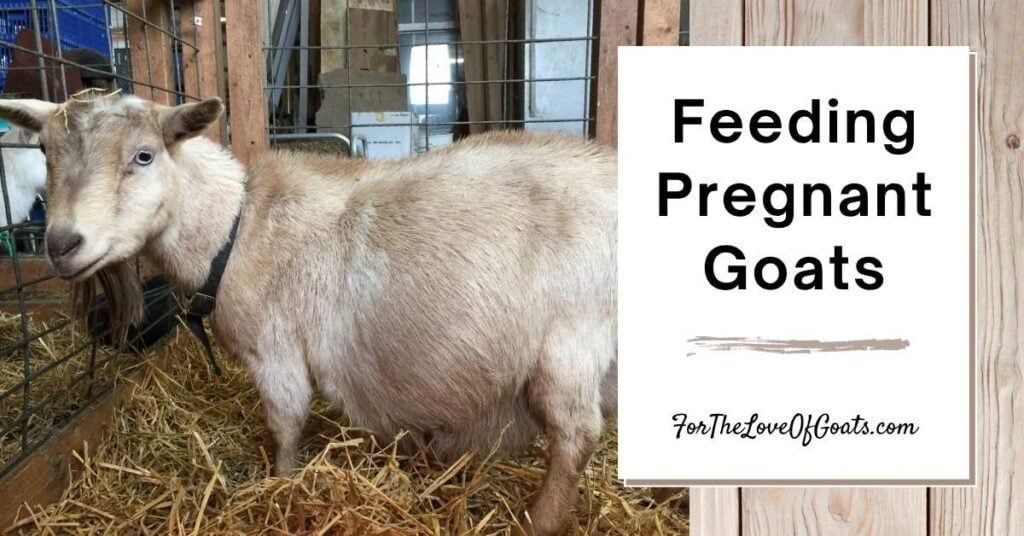
Proper nutrition during pregnancy is essential for keeping both does and kids healthy — but more isn’t always better! In this short, science-based episode, Deborah Niemann explains how to balance feed, minerals, and body condition during gestation, and why following feeding advice from other species (or even other parts of the world) can lead to trouble.
She also shares lessons from her own herd, including what happened when overfeeding resulted in giant kids, and how choosing the right hay and minerals can help prevent pregnancy complications such as hypocalcemia and toxemia.
Additional Information:
Listen right here
Watch the video version on Youtube
Don’t miss future episodes of For the Love of Goats!
Subscribe on Apple Podcasts, Spotify, iHeart, or your favorite podcast app.
Transcript
Deborah Niemann 0:00
Welcome to Goat Notes for goat nerds, where we take just a few minutes to give you a quick dose of science-based information for the love of goats. I’m Deborah Niemann, sharing simple evidence-based tips to help you become the expert on your goats on your farm.
Deborah Niemann 0:20
Nutrition during pregnancy is really, really important. Oh, it’s probably been seven or eight years ago since it was a study. And I put the word study in quotes, because not every study is a good study. Not every study tells us what we should be doing. You never want to just look at the results of a study and say, Oh, I’m going to do this. And that was the case with that particular study. It only had 12 to 15 goats, and it was in Africa, and they said that if you did not feed grain to your goats, that they would have all kinds of problems.
0:59
And the reality is, when you looked at these goats, like when you look at the outcomes for everybody, it’s like, well, yeah, the ones that didn’t get grain had a lot of problems. But even the ones who did get grain had a lot of problems. And this was in Africa, which is a completely different place, like they have completely different feeds, different climate, different everything than we do.
1:23
And I know I get contacted by people all over the world who have goat questions, and so I’ve never talked to anybody in Africa who has access to any kind of goat minerals. And the kind of problems that these goats were having had nothing to do with whether or not they were getting grain. They all were very much related to what looked like mineral deficiencies. And so it’s really important that you not just go, oh, well, this study said you should do this. Read the whole thing and see like, how was the study set up, where was it? What were underlying conditions?
1:58
In this case, the underlying conditions were the goats simply were not getting good nutrition, period. And so the lesson that we have to take away from that is that our goats need good nutrition during pregnancy, and that does not necessarily mean grain. It means that they need a good mineral. I’ve talked about minerals so much in so many videos. You know you want your goats to have – for a mineral that’s got around 15 to 20% salt – you want that mineral to have around 1700 PPM copper, and you want it to have about 50 PPM selenium. And the amount of zinc that it has should be about four times as much copper, because copper and zinc are mutually antagonistic, so too much of either one can cause deficiency in the other one. So copper and zinc always need to be in balance.
2:44
There’s quite a few minerals out there that just don’t have enough zinc in them, and all three of these, these are the most common minerals that goats in the United States and Canada become deficient in. So those are the ones why it’s really important to make sure that you have a good mixed mineral, loose goat mineral, that is available free choice, 365 days a year for your goats.
3:03
More feed is not better. If you overfeed a goat and she doesn’t need it, the extra calories and protein and calcium are going to go to the babies and grow bigger babies. The other thing is that an obese doe is more at risk for toxemia, because if she has a lot of internal fat, she’s not able to eat enough because the fat is taking up space in her abdomen that should be filling up with feed. So it’s really important that you not overfeed a goat, because you don’t want her to get overweight and you don’t want her babies to grow too big.
3:39
Another example I can give you on that is that many, many years ago, when we had a problem with dewormer resistance in our herd, we had a lot of goats that were very underweight, and so when they were milking, we were giving them an extra high protein feed. They had 30% protein to try and get some meat on their bones because the dewormers were not helping them, and I had tried everything anybody had ever told me, from Shaklee Basic H to all the herbs and the essential oils and all the things, and none of them worked.
4:09
So anyway, we were just trying to keep weight on the goats. My daughter misunderstood me, and she was giving that very high protein feed to the pregnant goats also. And that year we had some really, really huge kids, until I realized what she was doing and told her to stop.
4:27
So overfeeding goats is definitely not good. You want to be feeding them alfalfa hay for the last two months, because goats need a lot of calcium to grow bones in those babies. Now, if you’ve been online much at all, you’ve probably seen somebody say, don’t feed alfalfa to pregnant goats, because it causes hypocalcemia, and this, unfortunately comes from cattle research. Of course, there is massive, massive quantities of cattle research, because there’s so many cows in this country, and not very many goats, which is why so many people think goats are just little cows and like, oh, well, if this is true in cows, it must be true in goats.
5:09
However, one of the really big differences between goats and cows is hypocalcemia. So a cow almost always has a single, goats almost always have two or more babies, and so cows are much, much bigger milkers, especially modern dairy cows that are being given the hormones to produce more. Cows are much more likely to get hypocalcemia after calving, so they calve and their body kicks into gear, making massive quantities of milk, and that’s when they get hypocalcemia.
5:45
Goats, on the other hand, are much more likely to get hypocalcemia at the end of pregnancy, because their body is growing all of these fetuses, and every one of those babies has a lot of bones, so the goats are trying to grow lots of babies, and if they don’t have enough calcium, they wind up with hypocalcemia at the end of pregnancy, and toxemia can frequently be right behind that, because toxemia happens when there’s not enough protein.
6:12
Alfalfa is fabulous because it gives your goats lots of protein and lots of calcium. So if you are giving them 100% alfalfa, as long as they’re in good body condition and everything they should do okay without an added goat feed. However, if you can’t find 100% alfalfa, and you’re feeding like just a partial alfalfa, then that’s not enough protein. So you would at that point, add a small amount of the 16% protein goat feed to increase the protein.
6:43
However, there’s not much calcium at all in goat feed, so they really need a legume for that. If you’re in a part of the country that doesn’t necessarily have a lot of alfalfa, like in the southeastern United States, they have peanut hay. They also have sericea lespedeza. Both of those are legumes that are high in calcium and protein. So if you’ve got access to those hays, that’s awesome. You can feed those instead.
7:08
And that’s it for today’s show. If you haven’t already done so, be sure to hit the subscribe button so that you don’t miss any episodes. To see show notes, you can always visit fortheloveofgoats.com, and you can follow us on Facebook at facebook.com/lovegoatspodcast, see you again next time. Bye for now you.
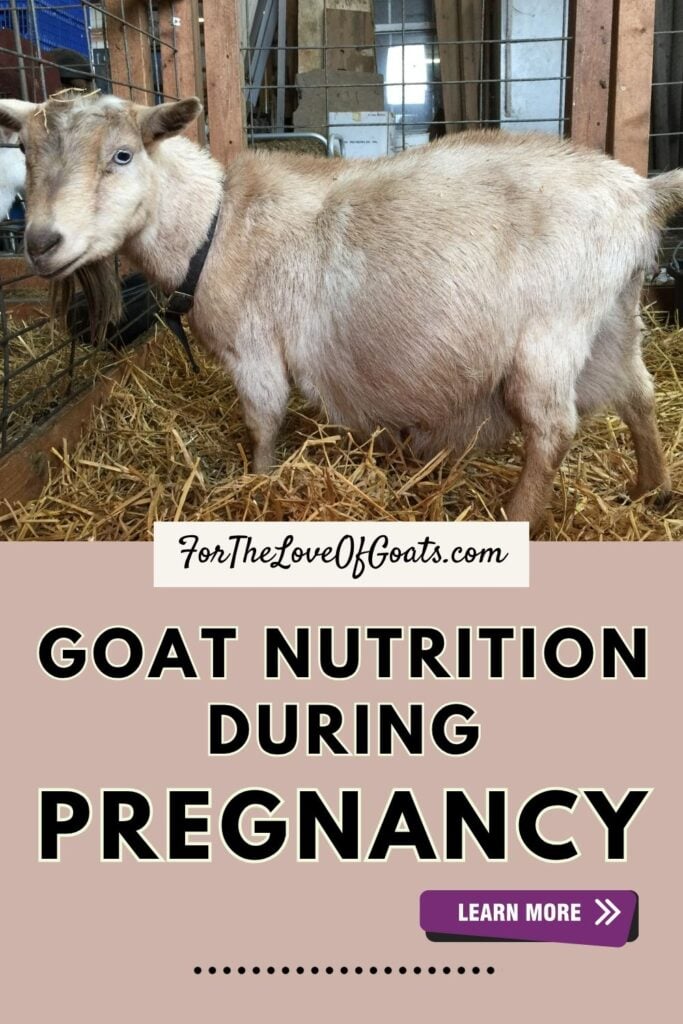
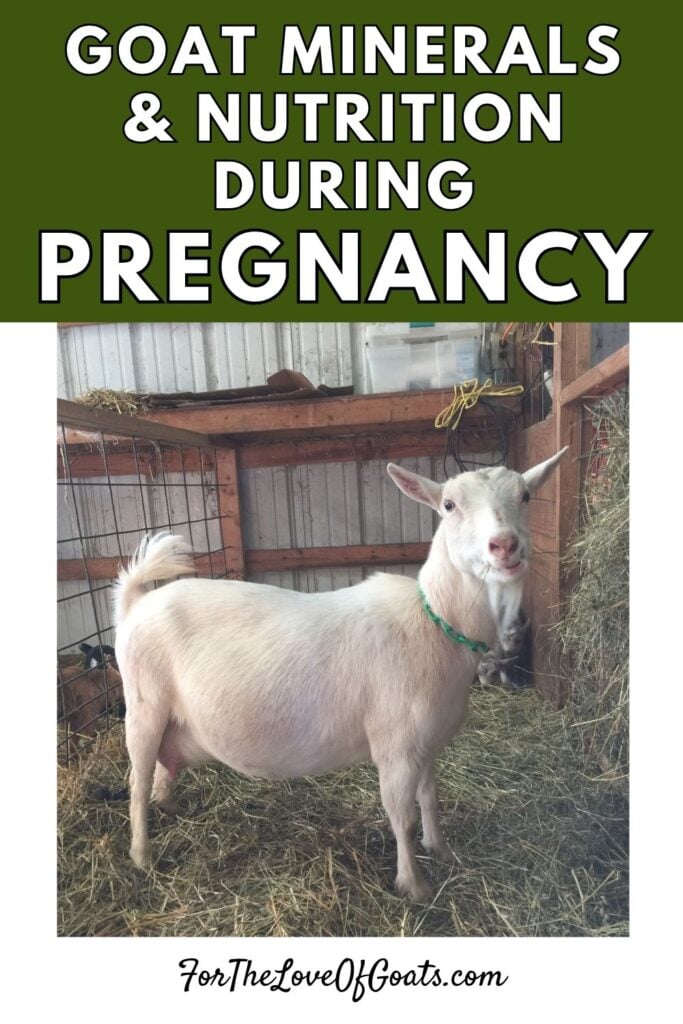
Pin for later!



Hello,
Is there a specific type of goat minerals that you recommend?
Thanks,
Melissa
Hi Melissa,
Great question! Yes — we do recommend a specific type of goat mineral.
You can find our full guide on what goats need, how to choose the right mineral, and how different brands compare here:
👉 Goat Minerals: Why, What, and How
https://thriftyhomesteader.com/goat-minerals-why-what-and-how/
~ Aimey, TH Team
I do not have access to alfalfa hay, only grass hay. I thought about using alfalfa pellets in the last two months of pregnancy.
How much alfalfa pellets should I feed a pregnant Nigerian Dwarf doe?
Do I need to add any grain to this ration, and if so, at what point in the pregnancy? Thank you!!
Hi Sara
You can use alfalfa pellets but will need to also continue offering the grass hay for the long stem forage.
Goats typically consume 3-4% of their body weight in forage daily. You can offer at least 2% of her body weight in alfalfa pellets and go up to 3% if she is carrying (or known to carry) multiples 🙂
If she weighs 80#, that would be a range of 1.6-2.4 pounds of alfalfa pellets per day.
Most dry goats do not need goat feed during pregnancy. It can lead to large kids that are hard to deliver if fed throughout pregnancy in any significant amount.
Does who are under conditioned when they get pregnant or are still in milk may require the extra calories. In addition, does who are cram-packed with kids may require it towards the end of pregnancy if they are having a hard time consuming enough hay to meet their energy demands due to decreased rumen capacity. So it really just depends for the grain 🙂
Tammy
I have 3 Alpine/Toggenburg does that are hopefully bred(1st fresheners..1st time goat owners), and we have always fed them an alfalfa mixed hay(about 30-40% alfalfa), plus around a pound of Kalmbach Goat Granola daily. they are due at the end of March, and we just started adding a couple cups of Alalfa pellets daily for each doe as well. Is that too much, too little alfalfa? They get free choice Sweetlix minerals as well. They have never been skinny goats…maybe even a little on the chunkier side.
It’s hard to say whether that’s too much or too little alfalfa without knowing their body condition. Could you let us know their age and when they’re due to kid? That will help us give a more accurate answer.
~ Aimey, TH Team