
When someone recently asked me in a Goats 365 meeting how to train a livestock guardian dog, my first thought was that I’m hardly an expert. I’ve simply been muddling my way through for the past 24 years.
But as I started answering the question, I realized that I have learned quite a bit in 24 years — usually because every new dog has taught me something, and sometimes because I made a mistake that I never wanted to repeat.
Livestock guardian dogs can be invaluable on a farm, but buying one is not as simple as finding a large white dog, putting it in a pasture, and expecting it to know what to do. The dog’s breed, background, temperament, introduction to your livestock, and early experiences all matter.
Here are some of the most important things I’ve learned.
A livestock guardian dog is not a herding dog
One of the most important things to understand is that livestock guardian dogs and herding dogs have completely different jobs and skill sets.
Herding dogs control the movement of livestock. Their behavior is based, at least in part, on prey drive. They watch, stalk, and chase animals to make them move.
A livestock guardian dog is supposed to live peacefully with the animals and protect them. These are typically the large breeds that weigh around 100 pounds as adults, such as Great Pyrenees, Anatolian Shepherds, and Maremmas.
People sometimes think “guard dog” means a German shepherd or another breed traditionally used to protect people and property. But that does not make the dog a livestock guardian. In fact, some of those dogs have a strong prey drive, which can make them dangerous around goats, sheep, and poultry.
Years ago, I knew someone who got a German shepherd–type dog from a shelter and put it with their goats. The dog chased the goats relentlessly and chewed on their ears, so the owners moved it into a perimeter pasture. One day they came home and found it eating a baby goat.
The dog was ultimately euthanized, which was tragic because it never should have been put in that situation. It was given a job for which it was completely unsuited.
Livestock guardian dogs are often big, stubborn, independent dogs that appear to be lazy most of the day. That is not a flaw. They are conserving their energy and remaining aware of what is happening around them rather than continually chasing or controlling livestock.

The dogs were doing more than I realized
We had dogs from the time we moved to our farm, so for years I did not fully appreciate how much their presence mattered.
Over the years, we replaced dogs as they passed away. But a couple of years ago, we found ourselves with no dogs at all. That was when the raccoons moved in as if we were running a fast-food restaurant for them.
During our first 22 years here, the dogs killed only two or three raccoons, and my husband shot another two or three. After all the dogs were gone, he killed well over a dozen raccoons within a few months—including three in a single night.
We also lost 20 or 30 chickens. Raccoons even ripped a piece of siding off our chicken house. At first, I thought we must have a bear because I could not imagine a raccoon causing that much damage.
I had not been in a hurry to get another dog because I did not think the absence of one would make such a difference. I was wrong. The presence of dogs had been discouraging predators from coming onto the farm even when the dogs were not actively killing them or chasing them off.
I finally realized that our chicken tractors and mobile housing systems worked largely because dogs were present. A livestock guardian can also provide a visible canine presence in a remote part of the farm, potentially discouraging two-legged predators, in addition to the four-legged ones.
Buy a livestock guardian puppy that was raised with livestock
Most livestock guardian training is on-the-job, which begins long before the puppy comes home with you.
We now look for puppies from a working farm that has the same type of livestock we own. It is not enough to see pictures of the adult dogs standing with goats. Ask where the puppies are actually living.
Are they in the house, in a kennel by the house, or are they growing up with the livestock?
Do not assume that because the parents work with goats, the puppies do too. I once made that assumption when buying an Anatolian Shepherd. When I picked up our puppy, the breeder told me that another puppy from the litter had recently been placed in a pasture with sheep the day the new owner took it home. A ewe immediately rammed the puppy and broke its leg.
A puppy raised among goats learns how to respond when a goat comes after it. Even at two months old, when a puppy may already weigh 30 pounds, a goat recognizes it as a predator. Some goats will charge the puppy as if their lives depend on it.
A puppy accustomed to goats will drop flat on the ground as the goat approaches. The goat, which had been aiming for a standing dog, suddenly has nothing to hit. It is amazing to watch, and it is something puppies learn through early experience with livestock.
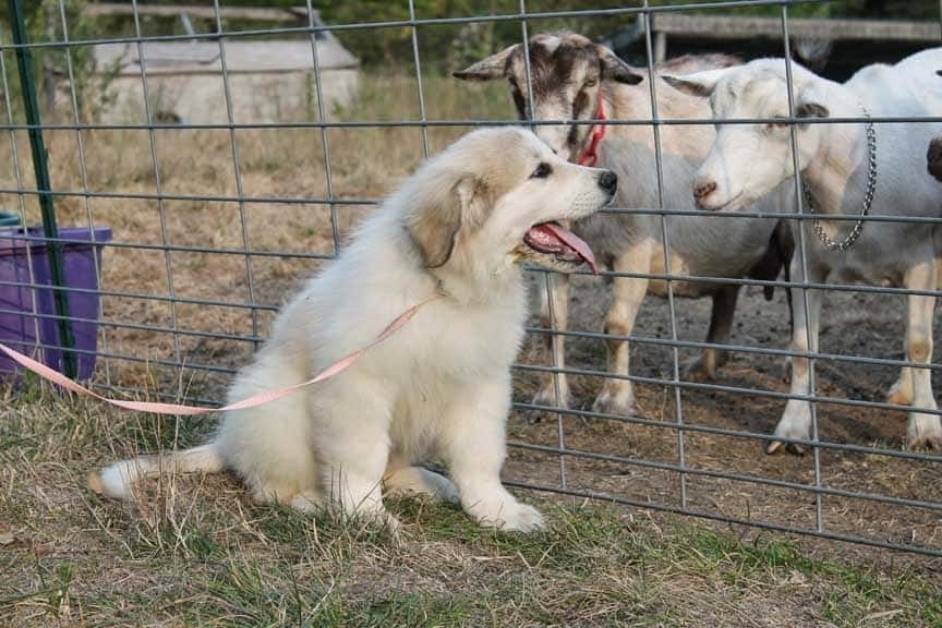
Louie, our current Great Pyrenees, came from a farm with Nigerian dwarf goats. He and his littermates lived in the goat pen. When we brought him home, I initially placed him in a kidding pen beside our bucks so that they could become acquainted through the livestock panels.
Every time we returned to the barn, however, the puppy had climbed into the pen with the bucks. We would put him back, and he would climb in with them again. After a few days, I decided he clearly knew how to behave around goats, and the bucks had accepted him.
He became completely bonded to those bucks.

Training a livestock guardian dog starts on day one
Even if a puppy has been raised with livestock, I introduce it to our animals through a fence initially. We typically use a kidding pen inside the barn so the dog and goats can see and smell one another while everyone remains safe.
You cannot simply drop an unfamiliar puppy into the middle of a herd and assume it will work it out. The puppy may not know how to respond appropriately, and a frightened or defensive goat or sheep can seriously injure it.
You should also pay attention to which animals the dog chooses to bond with. Our plan was to move our current dog from the bucks to the sheep because the sheep—and our hen mobile—were on the far east side of the farm, where we most needed protection. Almost 100% of our losses to predators have been chickens, so we need a dog near the chickens to dissuade predators.
The dog had other ideas. Every time we moved him into the sheep pasture, he went through two fences to return to the bucks. After several attempts, we accepted that he was bonded to them. We changed our plan and moved the bucks to the far pasture with the dog. The sheep now live on the other side of the farm.
Sometimes it makes more sense to work with a livestock guardian’s instincts than to keep insisting that it follow your original plan.
Choose the livestock guardian dog carefully
Temperament matters, especially if you want a dog that will live full-time with livestock rather than becoming a house pet.
When we selected our current dog, there were six puppies in the goat pen. Four immediately climbed all over us, wanting attention. One stood against the fence, and another ran back and forth along the back fence, never taking his eyes off us.
I looked at that watchful puppy, smiled, and said to my husband, “That is a livestock guardian.” That was Louie, the puppy we brought home.
A puppy that climbs into your lap and desperately wants your attention may become a wonderful pet or a dog that goes back and forth between the house and pasture. But it may not be the best choice if you need a dog that is content living outside and bonding primarily with livestock.
I learned this the hard way with a very friendly puppy I selected from a goat dairy. Lucy was the second successful livestock guardian dog we bought, and she was climbing all over me as I was trying to select my puppy from the litter. She loved me, but she was not happy when expected to remain outside with the goats.
At the same time, I would avoid a puppy whose primary goal is escaping. Our first three LGDs were terrible about escaping. When I was choosing that friendly puppy, another puppy spent the entire time at the gate trying to figure out how to get out. I knew immediately that she was not the dog for me.
Look at the parents too. Our first Great Pyrenees puppies had a father who was tied in the yard. In retrospect, that should have raised questions. Was he tied because he was an escape artist? Did he roam? Why wasn’t he loose with the livestock?
The behavior and working ability of the parents can tell you something about what you may see in their puppies.
Do not buy sibling puppies
It would have been bad enough to buy one of the puppies from that litter, but we bought a brother-and-sister pair, which was an even bigger mistake.
The two puppies bonded with each other, roamed, and killed poultry. The male eventually killed and ate a guinea. Ironically, our guineas had few problems with wild predators because they could fly so well, but they trusted the dog and did not recognize him as a threat.
Once I saw him eating a guinea, I knew the dogs could not remain on our farm. We rehomed both of them in separate homes as pets.
If a breeder encourages you to buy two littermates, they either don’t know what they’re suggesting or they’re just trying to sell more puppies. Raising one puppy is challenging enough. Two siblings can become more attached to each other than to the livestock and reinforce each other’s bad behavior, especially without an experienced adult LGD to correct them.
Livestock guardians and poultry can be a difficult combination
A dog that is safe with goats or sheep will not necessarily be safe with chickens, guineas, or other birds.
Birds are small, noisy, and “flappy.” Even in a dog with relatively low prey drive, all that movement can trigger chasing or grabbing behavior.
After the experience with our first Great Pyrenees, I researched other breeds and chose an Anatolian Shepherd partly because I found breeders who were successfully using them to protect poultry. Our Anatolian was not perfect—he was highly aggressive toward other male dogs—but he was the best livestock guardian we have ever had, and I would gladly have another Anatolian raised with livestock.
Individual temperament and early experience still matter, regardless of breed. No breed name guarantees that a dog will be safe with poultry, so it is still mandatory that a dog come from a working home.
Obedience training in livestock guardian dogs is valuable
Livestock guardian dogs are famously independent and stubborn. If you mention obedience training one, experienced owners may laugh or congratulate you because so few people attempt it.
I am very glad our oldest daughter took our Anatolian Shepherd through 4-H obedience training. When you have a 100-pound dog, it needs to listen to you.
Our Anatolian was extremely independent when he was loose in the pasture. But the moment you put a collar and lead on him, his behavior changed. He followed beautifully and did what he was asked.
You may not need—or even want—a livestock guardian performing elaborate obedience routines. But the dog should allow itself to be caught, handled, walked on a lead, and moved when necessary. You need a safe way to manage it for veterinary care and other situations.
We do not use food treats as the basis of our guardian dogs’ training. My concern is that a dog conditioned to respond to treats could potentially be distracted by someone throwing food over the fence. We use praise and other forms of correction or encouragement instead.
Adolescence can be challenging
Some livestock guardian puppies go through an obnoxious adolescent stage. They may chase livestock, play too roughly, or otherwise behave inappropriately.
If that happens, the dog should not be left unsupervised with animals it could injure. You can move it to a neighboring or perimeter pasture where it can continue to see and smell the livestock. Then bring it among the animals on a lead so you can stop undesirable behavior and praise calm, appropriate behavior.
A young dog should not be allowed to chase or harass livestock. Every time it repeats the behavior, that behavior becomes more established.
Roaming can also become a problem, especially as a dog reaches sexual maturity. Our current dog recently started wandering more despite being strongly bonded to the bucks. Because he is now about a year and a half old and likely finished growing, we are planning to have him neutered. We had delayed it because of current recommendations to allow large working dogs to finish growing before spaying or neutering. The appropriate timing is something to discuss with your veterinarian because it can depend on the dog’s breed, sex, health, and intended job.
Living outside is not a problem for the right dog
Some people cannot imagine leaving a dog outside because they love dogs and think every dog should be a house pet. But a true working livestock guardian is not simply a pet that has been denied access to the house.
The right dog wants to be with its livestock. That is where it belongs and where it is happiest.
Breeds like Great Pyrenees are also physically built for cold weather. Their coats become incredibly thick in winter. I have always said that if I were injured in a pasture during the winter, I would call the dog over, hug it, and bury my hands in its coat until someone found me. Even when it is zero degrees outside, the dog feels wonderfully warm beneath all that hair. I have even been known to cuddle with a dog in the middle of chores to warm myself up in winter.
Their coats do require some attention, especially during shedding season. Without brushing, the loose hair can form mats. However, shaving a double-coated livestock guardian in summer is discouraged because the coat also helps insulate and protect the dog. If you have questions about coat care or heat tolerance, consult a groomer or veterinarian familiar with double-coated working breeds.
Every livestock guardian has taught me something
After 24 years, I still don’t know everything about livestock guardian dogs. Individual dogs vary, and what works beautifully on one farm may be a disaster on another. But I have learned that details matter.
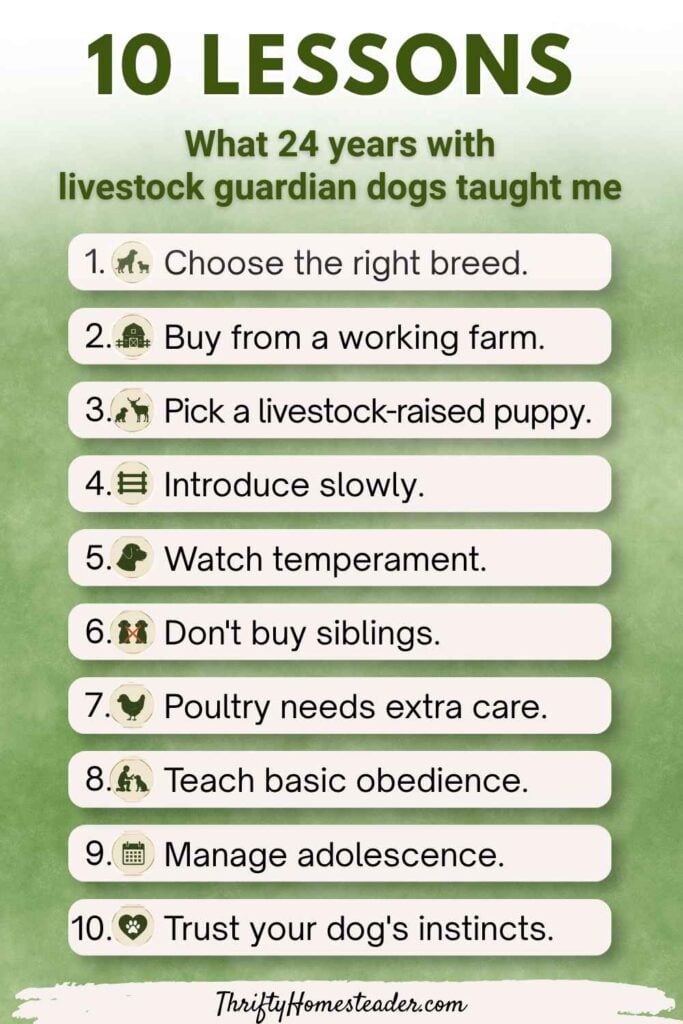
Choose a true livestock guardian breed. Find a puppy that has genuinely been raised with livestock—preferably the same species it will guard. Study the parents. Watch the puppies’ behavior. Avoid littermates. Introduce the dog carefully, provide basic handling and obedience training, and do not ignore adolescent behavior that could become dangerous.
Most importantly, do not underestimate the value of a good dog simply because you do not see it fighting predators.
For years, I thought our dogs were mostly lounging around the farm. It was only after they were gone—and the predators moved in—that I understood just how much work they had been doing.
Choosing and Training Livestock Guardian Dogs (Video)
Pin for later!


Your advice is very good, Deborah. We’ve had 8 Akbash (my livestock guardian of choice) in the past 23 years, and still have the last one. Livestock guardians have been bred for centuries to have a reduced prey drive and to bond with their livestock, but that doesn’t mean it’s automatic. It can easily take two years for a dog to be reliably left alone with stock. They need training and direction. They’re highly intelligent dogs who have been bred to make decisions on their own. If you put in the work when they’re young (really, should be done with any puppy), it pays off in the long term. Do your research. If you aren’t ready to put in the work with a puppy, know there are responsible, knowledgeable rescues, like Les and Kris Sharp from Colorado Akbash Rescue who may have a rescue dog that can meet your needs. In any case, livestock guardian dogs do not do well in shelters, so be responsible enough to make sure that if you do decide to get any livestock guardian dog, yours will never wind up in one.
Thanks for sharing your experience and advice Kat!
Tammy