Episode 180
For the Love of Goats
Kickstarter can be a useful option for farmers who have a creative project in mind but want to test demand before making a large investment. Instead of taking out a loan for equipment, products, or a new farm experience, a campaign can help show whether enough people are interested to make the idea worth pursuing.
In today’s episode, Deborah Niemann talks with Oriana Leckert, Head of Publishing at Kickstarter, about how the platform works and how it can be used for farm-related projects. They discuss why Kickstarter is designed for specific, creative projects rather than general business expenses, and why having an existing audience is one of the strongest predictors of a campaign’s success.
Deborah also shares what she learned from using Kickstarter to fund a glamping tent for her farm. She explains how the campaign helped her confirm that people were interested in staying on the farm before she purchased the tent. Oriana discusses how to choose a realistic funding goal, create appealing rewards, build trust with potential backers, and avoid common mistakes such as setting a goal that does not match the size of your audience.
They also talk about the difference between Kickstarter and GoFundMe, whether a campaign needs a video, how far in advance creators should begin preparing, and what to do if a project does not reach its goal. Oriana shares practical advice for first-time creators, including backing other campaigns, creating a detailed budget, involving your audience early, and beginning promotion long before the campaign launches.
Featured Guest
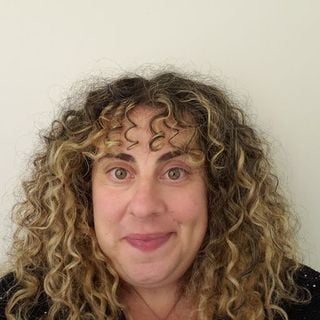
Oriana Leckert is the Head of Publishing at Kickstarter. She works with creators to help them understand crowdfunding, plan successful campaigns, and bring creative projects to life. Although her primary focus is publishing, she shares strategies that can also be applied to farm products, agritourism experiences, events, and other creative agricultural projects.
Resources & Links
- Kickstarter
- Kickstarter Creator Resources
- Check out our Goats 365 membership
Listen right here…
Don’t miss future episodes of For the Love of Goats!
Subscribe on Apple Podcasts, Spotify, iHeart, or your favorite podcast app.
Watch the video version
Transcript
Intro 00:03
For the love of goats, we are talking about everything goat. Whether you’re a goat owner, a breeder, or just a fan of these wonderful creatures, we’ve got you covered. And now, here is Deborah Niemann.
Deborah Niemann 00:18
Hello, everyone, and welcome to today’s episode. Today is definitely outside the box. If you saw the title and it said Kickstarter, and you thought, “I wonder what that’s about,” it really is what you think it’s about. It is about the platform Kickstarter, and we are doing this today because this is a great way for all of you who have dreams of a goat business to get funded, and we are joined today by Oriana Leckert, who is the head of publishing at Kickstarter. Welcome to the show, Oriana.
Oriana Leckert 00:50
Thank you so much for having me. This is an absolute treat. I do look at the world in terms of books, but I can’t wait to talk about goat milk soap and all kinds of other delights that are outside of my general scope as well.
Deborah Niemann 01:02
Yeah, and so it may not come as a surprise to those listening that Kickstarter does not have a farm specialist, and so we wound up with you because I met you a little over a year ago at a writers conference because this is a great way for a lot of people to fund self-publishing if they are writing a book, and so you were there to talk to writers about that, and that was how I met you.
Deborah Niemann 01:28
Then after I did my first Kickstarter just last month, which was funded, yay! I thought, you know what? Everybody who has a farm should at least be aware that this is a possibility in terms of getting funding. If you need something for your farm, that you don’t necessarily have to go to the bank and get 100% of it on a loan with interest and everything. Especially if you have a following.
Deborah Niemann 01:56
Actually, the first thing I did when I was preparing my Kickstarter last time was that I went into Kickstarter and I searched for farm projects and I found a lot because if you do that you can find the ones that were not funded as well as the ones that were funded and I wanted to look at both of those because of course I wanted to be funded and I thought there’s probably going to be some similarities that I see in the ones that don’t get funded, so I think probably the biggest mistake people make is thinking like, “Oh, this is a great way to just get free money from all the people. Like, build it and they will come. I’m going to create this Kickstarter page, and all these people are just going to come from nowhere and give me their money.” And that’s not exactly how it works. So, could you go ahead and talk about how it really works?
Oriana Leckert 02:40
Yeah, totally. That’s a great frame up. I actually forgot that we have a farm subcategory. I just pulled it up. There have been almost 2,000 farms projects funded, or at least launched on Kickstarter. Yeah, so I think I’ll just start by kind of like talking about Kickstarter and how it works overall, because I think that’ll be relevant to a bunch of the things that you just said. This is not directly relevant, but the first thing I always tell people is that Kickstarter is a public benefit corporation. That is deeply meaningful to me as an employee, and I think it is important for folks to know if they want to use the platform.
Oriana Leckert 03:10
I did not know what a PBC was before I came to Kickstarter, but it’s a fairly strict legal and business charter that turns us into a mission-driven for-profit organization. So everything we do has to come back to our mission, which is bringing creative projects to life. One of the ways that this is directly relevant to the, you know, how you teed me up. Kickstarter is designed for project-based fixed funding. It is intended to be creative things.
Oriana Leckert 03:32
So there’s a lot of people starting businesses on Kickstarter, but it’s like a business to make a particular product or a creative experience or something. So, like, to be a good Kickstarter campaign, the project has to be definable. Like, this is one specific thing. This project that we are making, it has to have some amount of creativity in it. There are other crowdfunding sites for this, but you cannot use Kickstarter for like investment funding, charitable donations. It has to be, or like general business expenses.
Oriana Leckert 04:00
So, you couldn’t say like we just want to keep the farm running. You could say we are, gosh, here I know so little about farms, going to make a haunted hayride for this Halloween season, or we are going to plant a whole new kind of crop. If it’s a tangibly definable, finite project with a creative element, that will probably work on Kickstarter, and then to your other point, this is crowdfunding. So it’s a specific kind of funding where you involve your community in the work that you’re doing.
Oriana Leckert 04:31
The number one predictor of crowdfunding success is how well you can reach that crowd. So you’re absolutely right. You know, a small percentage of people consistently to this day, who sort of close their eyes and plop out a campaign and wait to be showered by magical internet money? That is not how it works. Kickstarter is designed to have an amplifying effect. It’s a place for you to channel your existing audience and your support. If you bring your people to bear first, that’s going to signal to our algorithm and our discovery engine that, like, hey, this is a project people like. And then we will help elevate it to more and more people who just don’t know that they’re your fans yet.
Deborah Niemann 05:04
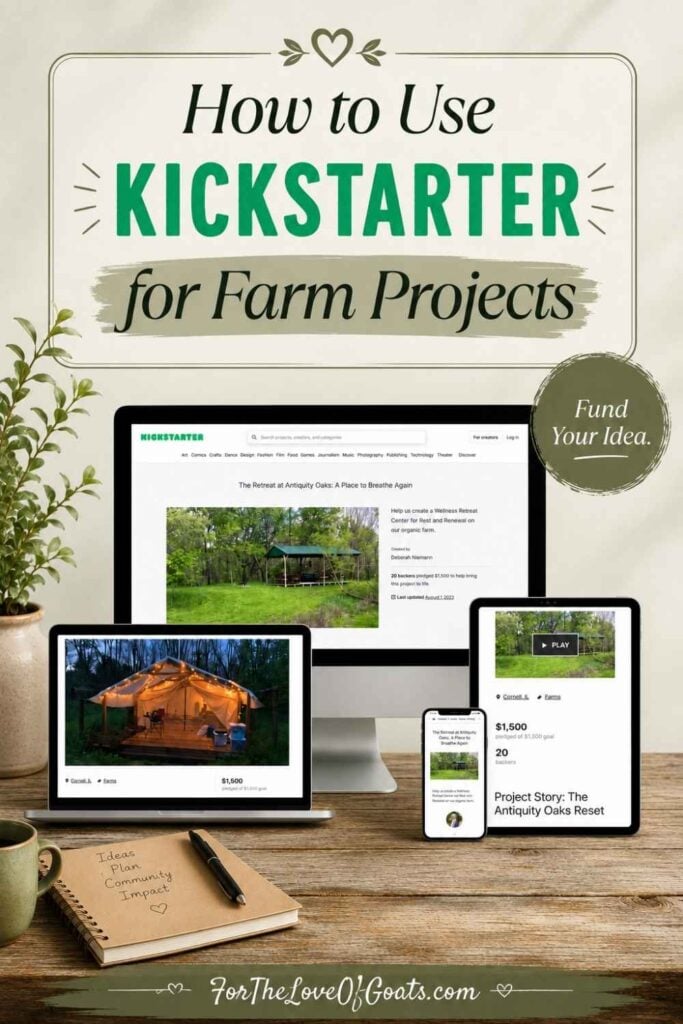
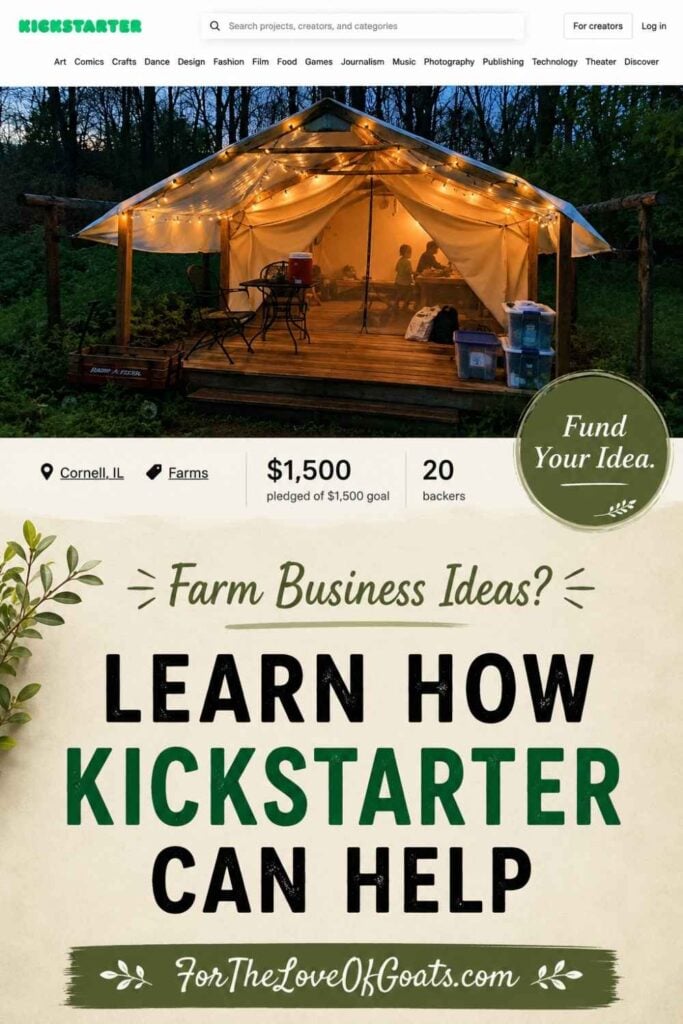
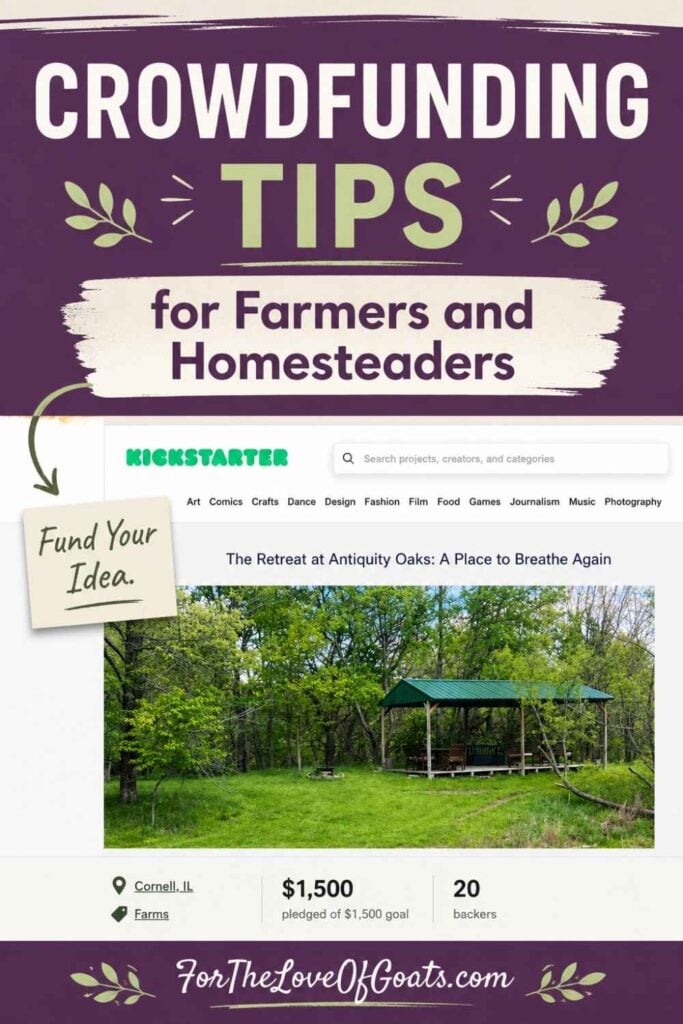
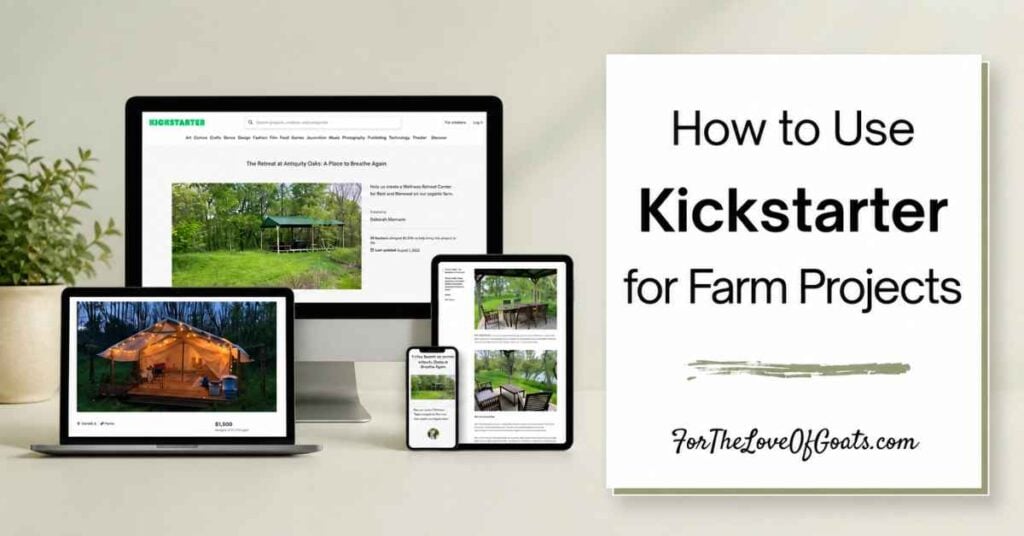
That is a great introduction to it. In case people missed our Kickstarter, what we did was we wanted to add a glamping tent to our farm where people could spend the night. Because it was only about $1,500 it was very tempting to just buy it, but I didn’t want to buy it if nobody wanted it. And I feel like that was my main reason for doing it on Kickstarter was that I wanted to make sure that people actually wanted this thing. I didn’t want to buy this tent and put it up and have it sit there with nobody using it.
Deborah Niemann 05:38
And so a big part of the rewards in the Kickstarter were getting like a night or two nights in the tent, as well as on-farm activities and stuff. And I think that’s one of the things that’s really important. You know, like if somebody wanted to do goat activities in their local area, you know, and they thought, oh well, I need to buy this trailer that’s like $10,000 or $20,000 or whatever. If you just go out and buy the trailer, like you know, you’ve got great credit. You get a loan and whatever you get it. But then, what do you do if the bookings don’t come through? You know, now you’ve got this monthly payment that you have to make on this trailer, and you don’t have the income to take care of it. So I think that’s one of the great things about Kickstarter is it helps you see proof of concept.
Oriana Leckert 06:27
Yeah, it’s great for market testing. I mean, we talk about this in terms of books in the sense of like, are you going to print a hundred books or a thousand books? If you have always written romance, is your audience interested in seeing you move into cozy fantasy? It allows you to check on what the people are interested in and sort of give them what they want or don’t.
Oriana Leckert 06:47
If there’s absolutely no interest in this thing that you’re considering buying or producing, maybe this is not the moment for you to buy or produce that thing, or maybe you need to do some more work to build your audience, to build a specific following that’s going to care about that kind of thing before you work with them to do it, and like, similar to your glamping tent. I mean, this is again, all of my examples will probably not be farm-related, but a project I talk about a lot, which is also not books.
Oriana Leckert 07:13
I live in Brooklyn, and many years ago, there was this couple who wanted to make a shuffleboard club in Brooklyn. You know, they needed a lot more money than they were likely to be able to raise on Kickstarter, so they had a lot of like work done for with individual and larger investors, etc. But when they were coming toward the opening, I think two months out from opening, they did a Kickstarter at the end to raise money for the courts themselves. So that was how they, like, framed it into a creative project just for the courts. One of their rewards was a Monday night shuffleboard league.
Oriana Leckert 07:42
Well, that turned out to be so popular that it sold out, and they wound up adding a Tuesday night and a Wednesday night league. And so, thereby, not only did they make a bunch of money and make a big splash in the media and local press about like this thing that they were doing, now they’ve got basically a bunch of people coming in three nights a week for every week just for these shuffleboard clubs. So that’s a way that like it signaled the interest, and they’re also like kind of guaranteeing themselves a lot of really strong sales before they’ve even opened their doors.
Deborah Niemann 08:16
One of the farm projects I saw actually was somebody who – this is probably like the extreme, you know. The goal was six figures, and it had zero backers, and it was a great idea. But the thing is, if you don’t already have an email list or a really big audience on one of the social media platforms or something like that to drive traffic there, people are not going to find your project. So, other than launching a project when you’ve got no way to send people to it, what is the next? I would think that’s the biggest problem. So, next to that, like, what’s the biggest mistake that you see people make?
Oriana Leckert 08:53
Yeah, I think, another way of saying that is that you have to make sure that your ambition matches your reach. Reaching for six figures when you have no audience – that is a great recipe for not succeeding. Also, choosing a funding goal that’s like wildly out of step, even if you have an audience, or if you have an audience for one thing, trying to raise a really huge amount of money that isn’t going to be borne out by the like level or type of success that already exists.
Oriana Leckert 09:20
You know, other than that, like I mean, you want to be really clear about the kind of thing that you’re making. Sometimes people rely, especially these days, too heavily on like AI art or on like prototyping without really understanding all of their sort of like production and manufacturing processes. Not doing a proper budget, aiming too high is no good, but so is aiming too low. I should have said this at the beginning for folks who don’t know: Kickstarter funding is all or nothing. So if you say we’re going to raise $5,000 and you only raise $2,000, you don’t get those $2,000. You don’t get any of the money.
Oriana Leckert 09:55
So that was actually designed with creative people in mind. Because you do make a lot of promises during the course of the campaign about the thing you’re going to make, how big it’s going to be, when it’s going to be done, how many pages it has, what color it is, things like that. And so, if you know that you need five grand to do this thing, and you wind up with only, you know, half that money, you’ve actually put yourself in a terrible spot. And so, we don’t ever want people to be trying to bring their creative idea to life with an incomplete budget. So, in converse to don’t aim so high that you don’t reach it, don’t aim so low that you are actually going to have to self fund or make an inferior product or something like that, and that’s going to be a disappointment for everyone involved.
Deborah Niemann 10:37
I am so lucky that Russell Nohelty is one of my friends, and we actually met as a result of both knowing him. And he’s done lots of Kickstarters, dozens and dozens of Kickstarters. He’s a self-published author. He launches all of his books on Kickstarter. And what I saw him say was that your goal should be a floor, not a ceiling.
Deborah Niemann 11:00
Your goal should be the price that you need to make your dream come to life, not your pie in the sky. Like, oh, wouldn’t it be wonderful if I had way up here? And that was why I set our goal at $1,500 because $1,500 would be the cost of that basic glamping tent. And I thought really long and hard about that, and the fact that I was thinking, if I don’t make $1,500, then this just isn’t the time. I don’t have the right followers, I need to expand my reach in this area, I don’t have the right audience. And it seemed modest enough, but also it was enough to make it happen.
Oriana Leckert 11:40
Yeah. So I think that’s exactly the way you should be thinking about what dollar amount that you should aim for.
Deborah Niemann 11:46
Because you see so many people saying really big amounts. Another one that I found, and I actually, I have a membership called Goats 365, and I actually dropped this into our community chat and said because it was again it was somebody with a really big goal, and they were not getting there. And I was like, “Okay, what do you think is wrong with this? Like, why do you think that they’re not doing very well?” In my mind, I was looking at it, and I’m like, “I am not really sure what you are getting. The rewards do not look good to me. Like I don’t think it’s worth $50 to name a chicken and get a dozen eggs.
Oriana Leckert 12:25
That’s a cute reward, though.
Deborah Niemann 12:27
It is. It’s an adorable reward, but maybe like for $10.
Oriana Leckert 12:32
Totally. And very expensive eggs.
Deborah Niemann 12:34
Yeah, those really expensive eggs. And I kept rereading it. I’m like, is this a subscription? Like, a dozen eggs for 10 weeks or something. I’m like, surely they don’t. That’s not really the reward. And one of the people in the group said, “This looks more like a GoFundMe than a Kickstarter.”
Oriana Leckert 12:54
Yeah.
Deborah Niemann 12:54
So can you talk about the difference between them?
Oriana Leckert 12:57
Yeah. Totally. I think that’s such an important point. Like, understand the platform you’re using. GoFundMe is an open-ended funding platform. It’s essentially charitable giving, which is lovely. No problem with that at all. You’re just saying we need help with this thing or that thing, and we’d like our community to support us.
Oriana Leckert 13:15
With Kickstarter, it is not charitable in that framing at all. You are asking for community support, but everybody gets something in return. It’s very rewards based. It’s designed, like to make a product, a game, a record album, a line of soap, a gadget, an event where everyone gets something in exchange for their support. So yeah, I think the rewards are actually the coolest part of the Kickstarter proposition. It’s like what makes this kind of fundraising really uniquely compelling. I mean, again, I can give a lot of examples in the book world, which won’t necessarily translate for farm people.
Oriana Leckert 13:51
But I will say before I do that, the best thing you can do for yourself, if you’re even a little bit Kickstarter curious, is to back some campaigns, even for a couple of dollars here and there, just to see what other people are doing. It is first of all understanding the Kickstarter sort of proposition as a backer will give you a ton of ideas about what to and what not to do as a creator. It’s excellent for research purposes. It also will show you that it’s, like, really fun, like a well-run Kickstarter campaign. You feel really good about supporting someone else’s creative work. It’s very exciting to watch them like hitting milestones and communicating about it. And all of the rewards that I can talk about or that I will now list, I didn’t come up with them. It’s just what I’ve seen from other people.
Oriana Leckert 14:34
So, it’s really excellent for you to think. Well, okay, Penny Reed is a romance novelist. Her heroine is a knitter, so in her campaigns, in addition, of course, to the books, she got a friend who runs a yarn store, and they make a custom color of yarn and some custom knitting patterns that are available through every campaign. So maybe that’s not what you’re doing exactly, but think about the friends that you have. Think about the folks in your community who do adjacent work or wildly different work, and maybe they want to share some of their stuff in your campaign. Then that can be some rewards that you give out. There’s lots of ways that you can think about rewards and the stuff you’re going to do in addition to the kind of main thing you’re making that’s going to, like, delight your backers and your community and make them really excited about being part of this creative endeavor that you’re doing together.
Deborah Niemann 15:23
Yeah, that sounds so cool to partner with like a local yarn shop when your heroine and your novel is a knitter. I’m sure that there are lots of things that people who are in the farming community could do with other local farmers to bring them in.
Oriana Leckert 15:39
Yeah.
Deborah Niemann 15:39
And that also helps that other person’s business.
Oriana Leckert 15:42
Yeah, it’s a symbiotic relationship. You’re cross promoting what each other does in a really beautiful way. I mean, you could bring 10 farms together and have your top reward be cheese from this farm and vegetables from that one and ceramics from this other person.
Deborah Niemann 15:59
Wow, that would be great. I love those ideas. One of the things that I really dragged my feet on was creating a video. And I kept seeing this thing pop up as I was working in the back end about what percentage were more likely to succeed if they had a video. So can you talk a little bit about the video and how long it needs to be, what kind of quality people need to be striving for, that sort of thing.
Oriana Leckert 16:25
Totally. I will start by saying there is, for sure, a preference for videos on Kickstarter, but it is not a requirement. I always tell my creators if that’s the thing that’s keeping you off the platform, that’s the stumbling block that’s too big. It is okay. Plenty of campaigns run and do beautifully without a video. I will also say, my partner, the way that he consumes the internet is he wants everything in a video format. He cannot be bothered to read words.
Oriana Leckert 16:50
I am the opposite. I’m actually so mad when my computer or my phone starts like playing something at me when I haven’t explicitly asked it to, and I really want, as a writer and a reader, to read all the words. So this is just a way of saying there are like many different kinds of people who consume the internet in many different kinds of ways.
Oriana Leckert 17:08
Doing a video does let you appeal to all those folks who are sort of much more visually inclined. I will also mention we are just now, I think this week, rolling out a new in our mobile app, a new vertical video discover carousel, like it’s very TikTok inspired. You can just see the feed as videos, and you can scroll the videos just like on Reels or anywhere else.
Oriana Leckert 17:32
So this is the third time in my career I’m being sort of forced to pivot to video, but this is one that I actually think is a good job. So anyway, all of that to say, if you are going to do a video, my best advice is to make it short, bright, and compelling. Most of our data shows that,like, about 50% of viewers leave after the first minute, so you do not need to undertake a vast Hollywood production level, extremely expensive video shoot. Really, you just want it to be a little teaser that get people excited about what you’re doing and why.
Oriana Leckert 18:04
It’s great to show yourself if you feel comfortable doing so. There are people, there’s a bit of a cult of personality on Kickstarter. Folks really want to know who it is that they’re supporting, and if you have some of the thing that you will be making, if you can show that, if you can show your farm, if you can show your CSA haul. If you can show your glamping tent or your whatever, that’s going to make people get a really better sense of, like, what this is and why they would want to support it.
Deborah Niemann 18:31
Awesome. I know one of the mistakes I made was thinking that I was going to put this thing together in a couple of days and do it. That happened a little bit because I happened to see Russell talking about Kickstarter in May, and I thought, “Oh, this is perfect! I’m gonna put this together. It’s gonna be done, and I’m gonna get this tent out there by early June, and people will be staying in it all summer. It actually took me longer than I expected. The deadline was finally set for July 1st. I don’t know, maybe I was slow, but how far in advance should someone start planning if they want to do a Kickstarter? Especially because a lot of stuff on a farm is seasonal.
Oriana Leckert 19:13
Totally, it really varies pretty widely for each person, their team, their sort of bandwidth, like all the other things that they are thinking about and working on. Actually, putting like writing the words onto the page is not going to take you that long, but you do need to definitely leave yourself time for budgeting, for making the video we were talking about, for figuring out what your rewards are going to be, and doing all the work to source those and budget for that. Any those things as well.
Oriana Leckert 19:42
You’re also going to want to think about what is going to happen while your campaign is live. What is the running of your campaign going to look like? How many emails are you going to be sending? Do you have a social strategy and what is it? Who are the people who are amplifiers, signal boosters, influencers, folks who can reach their own audiences? How are you going to get in touch with them? What are you going to say? Like planning out all of those things is really what takes the longest. So, as I said, if you’ve got an hour a day to devote to this, give yourself many weeks. If you have many hours a day to spend, probably you can get it done much more quickly. But yeah, it really depends on everything else that’s happening in your life.
Deborah Niemann 20:21
So what exactly makes people trust a campaign enough to back it?
Oriana Leckert 20:25
Well, there is not one magic formula. I’m sorry to say, if I knew that every single person I talked to would be vastly overfunded in their first day, I think you want to put yourself in the backer’s shoes. Have you written the story page in a way that it gives people faith that you actually can do this thing?. Does it seem clear? Do you have a lot of illustrations or photos? Have you demonstrated who you are and like whether you have a track record of work like this, that kind of thing? The rewards themselves have to be compelling and also priced in a way that make people feel good about supporting that.
Oriana Leckert 20:59
I mean, in books, the average pledge amount has gone up every year for at least six or seven years. It’s currently $78, which is wild. Like that’s so different than sort of like standard online book buying behavior, which is like find the 99 cent ebook and be done with it. So Kickstarter is definitely a place that people are willing to spend money, but it has to match, you know, as you exactly just said. How are people going to feel spending $50 for a dozen eggs? If that doesn’t feel great to you, it’s probably not going to feel great to your backers. And a lot of this, you know, Kickstarter is really designed to, like, bring you closer to your supporters.
Oriana Leckert 21:38
So there’s definitely a good amount of work that you can do before you launch of talking to your audience. If you have a big mailing list, you know you can say to them, “We are thinking about starting a line of soaps. Do people want it? What would be, like, three scents that you would really want to see? What would be a good price point for you to feel good about supporting?” You know, like, work your audience into the process long before you launch, giving them buy-in, making them feel connected to it, and also getting them really excited to support it when you are live. That can be the best kind of market testing that there is because your audience is going to be different than anybody else’s audience.
Deborah Niemann 22:16
Another question, kind of back to that goal of or that reward where you got to name a chicken. Are physical rewards generally more successful than digital ones or experiences?
Oriana Leckert 22:26
Physical rewards are the do rule in Kickstarter for sure. I mean, again, in the book side, we see a lot more traction with like special editions than for audiobooks, for example. That’s not to say that digital rewards are not also very nice and can do fine, but there is generally a preference. And then I think experience rewards. I don’t have like statistics of like percentage better or worse, but that is the kind of thing where that does make people feel really personally connected to what you’re doing. So I would imagine most people will see like lower numbers of people, but higher dollars spent on something like a launch party or a club or like a Discord community to like talk about or interact with the thing that you’re making.
Deborah Niemann 23:13
And then once they’ve got everything put together and the Kickstarter launches, the other thing too, just as an aside, once you hit that launch button, you cannot change your deadline. So…
Oriana Leckert 23:24
Yeah, that’s true. You can continue to edit. You can put in a new video. You can change your copy, your images, whatever. The things you cannot change once you’ve pressed that launch button are your total funding goal, the date and time that your campaign ends, and any rewards that have already got backers-that stuff is lost once you go live.
Deborah Niemann 23:44
Once you start and things are not going quite like you hope, what can creators do to help things try to pick up if it’s going a little slower than you thought?
Oriana Leckert 23:54
I think first you need to look at your outreach and your promotional plans and see, like think again about every lever that is available to you to reach people. Should you be texting your closest friends? Should you be doing more Instagram Reels or YouTube Lives or, whatever, posting in different subreddits? Like, think about all the ways that you can reach your specific audience, and then think about the ways you can get beyond that. Is there a local newspaper left in your town that might write about it? Are there other folks with podcasts or Slack communities who might be willing to talk about what you’re doing to their audiences?
Oriana Leckert 24:34
You know, just really think about all the ways that you can spread the word out in the world. That’s going to be the main thing. You can always look back at your project page. Could you have made the pictures better? Could you have made the copy tighter or clearer? Are there other rewards that you can offer that might have made more sense? But there really is a limit to like how much it matters, each specific element of the page. It’s really just about how well you’re getting out there and reaching the audience that you have and the audience that you want and getting them excited about what you’re doing.
Deborah Niemann 25:06
What happens if you don’t reach your funding goal?
Oriana Leckert 25:09
The answer is nothing. You don’t owe anybody any money. The way that money works on Kickstarter is that no funds are actually collected until the campaign ends, and then only if it has reached its goal. So there’s no paying people back. There’s no refunds. There’s no mess. You don’t owe Kickstarter any money. You just, now you don’t do the thing. Then you sit down and you think about all of the lessons that you’ve learned because you certainly will have learned so much about what worked and what didn’t and what you could have done better and differently.
Oriana Leckert 25:34
And you decide if you want to scale back the project and do a smaller version, if you want to take some time to build your audience and your connections to them further before you think about launching another, maybe Kickstarter is not for you. Maybe there’s a different kind of fundraising that might make more sense. You just sort of synthesize all of that information and you decide what you want to do next, if anything.
Deborah Niemann 26:00
I think that’s something that people might not have even thought about. Like, okay, well, if I’m not successful this time, maybe I can figure out what went wrong and come back and try again.
Oriana Leckert 26:09
Absolutely, yeah.
Deborah Niemann 26:10
Do you see that?
Oriana Leckert 26:12
Totally, yeah. Very often, there’s, in one of our case studies, it’s a pepper grinder, which I actually backed. It’s like a… I’ll show it to you today. It’s this like special wooden ergonomic pepper grinder with like fancy peppercorns from Madagascar or something. Anyway, they ran the campaign and it didn’t fund. And then they licked their wounds. They took a hard look at what they did. They took a lot more time to prepare and they came back and they earned like six figures. And now they make these gorgeous pepper grinders. So yeah, that absolutely happens all the time.
Deborah Niemann 26:42
Wow, that is amazing that somebody would fail to fund and then come back and make six figures.
Oriana Leckert 26:47
I can try to find that article.
Deborah Niemann 26:49
What an incredible success story!
Oriana Leckert 26:52
Yeah, case study: how Piper went from a failed campaign to funding in 14 minutes.
Deborah Niemann 26:56
So, what do successful creators do the second time around, that helps them to become successful.
Oriana Leckert 27:03
It depends on what didn’t work out the first time. It’s usually some combination of changing what they’re making, decreasing their funding goal, changing the way they talk about it, reassessing where their audience is, and like figuring out new and better ways to build that up and ways to find them.
Deborah Niemann 27:20
What do successful campaigns have in common?
Oriana Leckert 27:23
Yeah, I mean, I think a lot of the same stuff that we’ve been talking about in various forms. I think they have good imagery. I think they have clear communication in their story section. I think they have an interesting, creative thing that they’re making, and I think they have a good understanding of digital marketing and where to find their people, and what those people would want, and how, whether, and how they can give it to them.
Deborah Niemann 27:44
What advice would you give someone who wants to launch their first campaign six months from now?
Oriana Leckert 27:48
Back other campaigns. Start now. Start today. Even for $1. Back campaigns that are similar to yours. Back a couple of campaigns that are really different from yours. Our games community is the most active and the most vibrant on Kickstarter, so I would back a couple of board games, probably tabletop board games, just to see what that’s like.
Oriana Leckert 28:08
Kickstarter is a vast historical repository of Kickstarter. Every campaign that has ever run is still visible on the site. So you can do all kinds of research of like, show me all the projects this year that funded between ten and a hundred thousand dollars, and you can start to look at what they have in common and what rewards they’re offering, the frequency of their backer updates, the order they put their story section in, like all these sorts of things like that.
Oriana Leckert 28:35
So that’s my number one advice: back other campaigns, get yourself accustomed to this particular platform and what it’s like.
Oriana Leckert 28:43
Step two: make a budget. Do not skip the budgeting step. Do a real live budget with all of the different elements. We’ve been talking about, Russell. I commissioned him to write an article for me a couple of years ago. That’s like a guide to budgeting for your Kickstarter publishing project. It’s called “How to Create an Expert Kickstarter Budget.” It’s on our blog, so that would be a good place to start. I know one thing that I always say that puts in here, in addition to all of his manufacturing and production, and bubble mailers and tape. He says always include a line item to do a nice thing for yourself. Russell gets a tattoo after each of his successful campaigns, but I’ve also heard of people getting a massage, taking themselves out for a nice dinner, you know, do a little bit of self care as a reward for all your hard work.
Oriana Leckert 29:26
And I think the next thing would be connect with your audience first, and just start sharing, start seeding the idea of the project. Not even necessarily saying the words crowdfunding or Kickstarter. Just like, guess what? We’re gonna make a new line of marmalade because we’ve got all of these fruit trees and they’re blooming and like we’ve got new flavors and we’re really excited and like stay tuned. I’ll tell you more as it develops.
Oriana Leckert 29:51
That way, once you do say, “And we’re gonna do it on Kickstarter, and we need your help, and we’re so excited,” they will already have it in their mind that they’ve been thinking. They can’t wait for those exciting new things, and they’ll be a lot more willing to come along with you. Maybe they’ve never made a Kickstarter account before. Maybe they need a little bit of coaching about how this works and what you do. But anyway, if you sort of seed the ground that way, by the time you get around to it, they’ll already be excited and ready to hopefully support you when you’re live.
Deborah Niemann 30:18
I think that’s great advice to back a Kickstarter first because especially if somebody asks you, you know, like they’ve never done it before, and they send you an email and say, “Hey, I want to back your thing, but how do I do it?” Then you’ve got that firsthand experience where you actually did it, where you created your account and you gave the $5 or whatever, and then you saw when the money was deducted and everything. You’ve seen it from the supporter side.
Oriana Leckert 30:46
Totally.
Deborah Niemann 30:47
Well, this has been so interesting and helpful today. I’m excited to see what our listeners do and what kind of Kickstarters they come up with for their farm.
Oriana Leckert 30:56
Yeah, and let us know. I work on the outreach team, so I’m obviously publishing specific. But we’re a big team, it’s a bunch of people. Like you said at the beginning there’s no one who specializes in farming, but we have creator support specialists in the creative categories, in the design and techy categories, and games. You can write in and get in touch with people, ask questions. We’ve also got a robust customer support staff, and also like our materials are vast for we’ve got video tutorials, we’ve got all kinds of articles and spotlights, and I think if you just go to Kickstarter.com/creators, that’s the hub for where everything starts.
Oriana Leckert 31:30
Our help center has an endless number of articles on every single weird techy nuance of the project. But anyway, let us know. We’re here to help you. You don’t have to be in touch with anybody to launch a Kickstarter, but certainly we would love to do what we can to offer you strategic guidance and support. So obviously, we all really believe deeply in what we’re doing. We had our all hands meeting this afternoon, and whenever we have that once a month, we usually ask creators to send in little videos of like, we call it the “Why Our Work Matters” section. So it’s really nice, especially for like the engineers and the like non-creator facing teams to hear from our people who say, “My whole business couldn’t exist without Kickstarter. My entire publishing practice, my entire film career” Kickstarter allowed all of these dreams to come to life. And yeah, we just love to hear from our creators and help them however we can.
Deborah Niemann 32:22
Yeah, that’s one of the things that really surprised me when I saw you at that conference a year ago, was like, oh my gosh, Kickstarter like sent a person here, and then you gave everybody your email address and said email me, and I did, and we met and talked. And then when I was having a little trouble, I emailed you again, and you responded. Like you are real people who really believe in what you’re doing. You want to help people succeed with their journey.
Oriana Leckert 32:48
Yeah, we really do.
Deborah Niemann 32:49
And it’s cool. I didn’t even know that you were a B Corp, so that’s even more exciting.
Oriana Leckert 32:53
Yeah, that’s really meaningful. I’ve been at Kickstarter seven and a half years. It’s the longest I’ve been at any company, and it is really, really meaningful to me to work for a PBC.
Deborah Niemann 33:01
Well, thank you so much, and we’re gonna be in touch as more of us do Kickstarters.
Oriana Leckert 33:06
I’m so excited! I’m so excited for all your listeners. I can’t wait to hear what you guys come up with. I can’t wait to back some of your campaigns.
Deborah Niemann 33:14
Awesome.
Deborah Niemann 33:16
And that’s it for today’s show. If you haven’t already done so, be sure to hit the subscribe button so that you don’t miss any episodes. To see show notes, you can always visit fortheloveofgoats.com, and you can follow us on Facebook at facebook.com/lovegoatspodcast. See you again next time. Bye for now.
Pin for later!