
Recently, there’s been a surge in misinformation online claiming that lye (sodium hydroxide) can be used to deworm goats and other livestock. These claims are not only unsupported by science — they’re potentially life-threatening to animals — for two reasons.
Let’s break down the facts, the myths, and the dangerous assumptions behind this trend so you can make informed decisions to keep your animals safe.
The Core Claim: “Lye Kills Worms”
A viral video is circulating suggesting that mixing a small amount of lye into an animal’s feed can kill intestinal parasites. This claim comes from labels on lye cans in the early 1900s that claimed adding lye to pig feed would prevent hog cholera and kill worms.
“Prevents hog cholera, destroys worms, adds juicy flesh.”
— Merry War Powdered Lye, early 1900s tin display advertisement
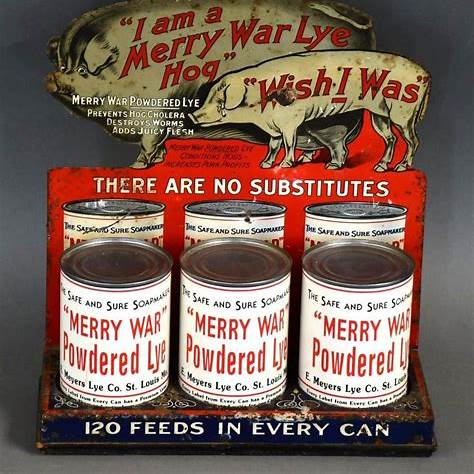
In the early 1900s, farm magazines and other printed materials were filled with wildly inaccurate advertisements, largely because there were no consumer protection laws or truth-in-advertising regulations in place at the time.
Spoiler alert: there is no scientific evidence that lye is an effective or safe dewormer in live animals.
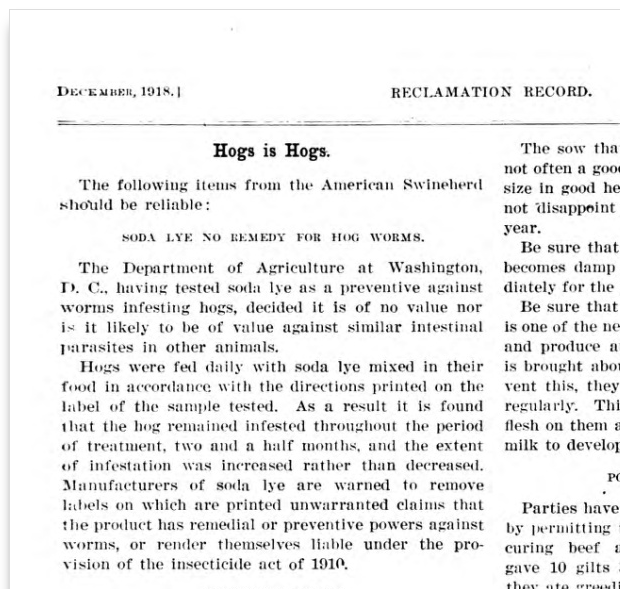
In 1918, the Reclamation Record reported that the Department of Agriculture had tested lye as a dewormer in hogs and found that it had no value in reducing their wormload. They also warned lye manufacturers that if they did not remove the claim from their labels that they would be held liable under the Insecticide Act of 1910.
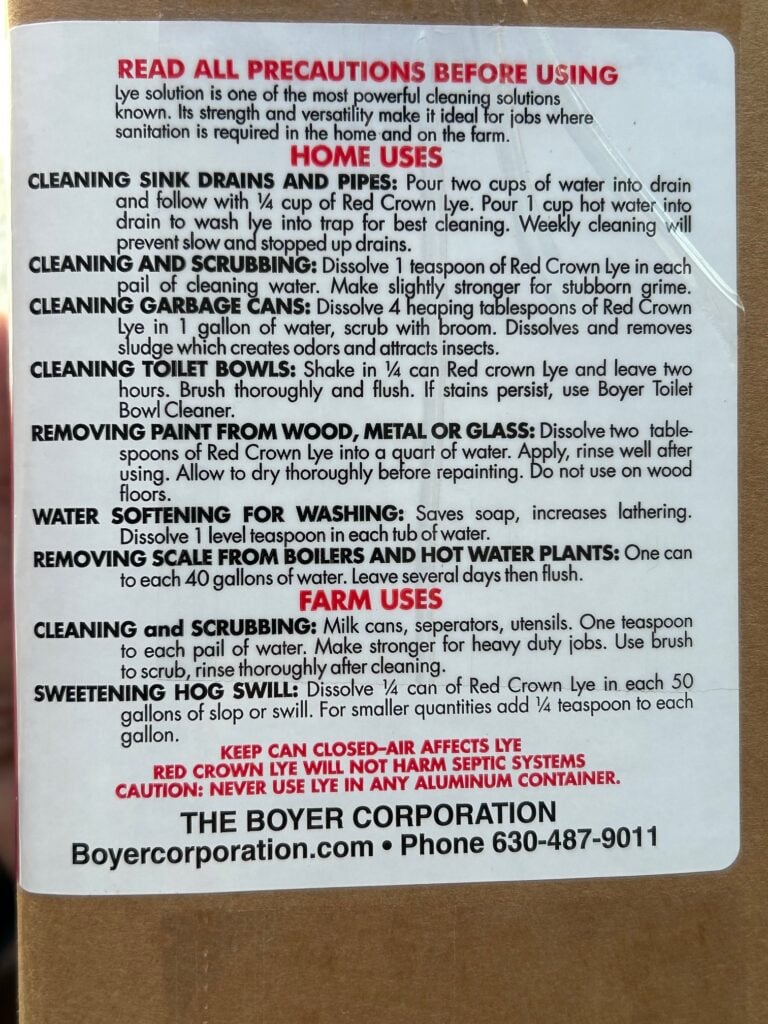
Lye labels today mention nothing about using it as a dewormer, although they do mention it being used to “sweeten hog swill.”
In early 20th-century farm advertising, the term “sweeten hog swill” referred to the practice of adding lye (sodium hydroxide) to reduce the sour smell and acidity caused by fermentation in leftover food or mash fed to pigs. Lye is a highly alkaline substance, so adding it to swill raised the pH, neutralizing the acids produced by bacteria and making the mixture smell and taste less offensive. However, the word “sweeten” didn’t mean adding sugar or making it more nutritious—it simply meant masking spoilage by altering the chemistry.
While this may have made the feed more palatable, it did nothing to improve its safety or nutritional value—and certainly didn’t justify the health claims companies made at the time.
Some sources say that adding lye makes grains easier to digest. When we raised pigs, we noticed that if we fed them pure corn, we saw corn in their poop. However, if we simply soaked the grain overnight in water, the pigs were able to actually digest it, and we saw no corn in their poop. So the benefit of adding lye for that purpose is questionable since soaking in plain water appears to do the same thing.
What the Studies Actually Say
Some people are pointing to in vitro studies (studies done in a lab dish, not in living organisms) that show sodium hydroxide can kill parasite eggs at a 1% concentration. This is being misinterpreted in several dangerous ways:
- In vitro ≠ in vivo: Killing worm eggs in a petri dish doesn’t mean it’s safe or effective to do the same inside an animal’s digestive system. The 1926 study being cited was done to find a way to kill worm eggs in human feces so it could be used as fertilizer. They never suggested humans or any other living creatures ingest lye to kill worm eggs.
- Concentration matters: A 1% sodium hydroxide solution, which was used in that study, has a pH of around 13.4 — strong enough to cause serious internal damage if ingested.
- There is no published research on using lye as a dewormer in live animals, and no support for it in veterinary medicine.
“But It’s Just a Small Amount…”
Some people argue that the lye used to “deworm animals” won’t hurt them because, “It’s just a tiny bit!”
But that is why it won’t kill worms. The only way for lye to kill worms is to dissolve them, which it could do at 1% — but even then, it only killed 67% of the eggs in the in vitro study.
But if it’s strong enough to dissolve worms, it’s strong enough to damage the esophagus, stomach, and other organs of the animal that ingests it.
Here’s another interpretation of how this works.
“But It’s Used in Food”
Yes, sodium hydroxide is used in food processing—for example, in making pretzels or curing olives—but these are tightly controlled applications where the lye is:
- Used externally (not ingested)
- Neutralized by cooking or rinsing
- Never fed directly to animals or humans
Saying that “lye is in food, therefore it’s safe to feed it to goats” is like saying, “bleach is used to clean lettuce, so I’ll pour some in my smoothie.” Not how it works.

The Caregiver Placebo Effect: Why People Think It Works
So why do people believe lye is helping their goats? The answer lies in psychology, not pharmacology.

In a 2012 veterinary study, researchers found that nearly half of dog owners and vets believed dogs with arthritis had improved with treatment—even when objective measures showed no real change. This is known as the caregiver placebo effect.
A literature review in 2017 looked at six placebo-controlled studies of analgesics in cats with degenerative joint disease-associated pain. Across six studies, a shocking 50-70% of owners called the treatment a success compared to only 10-50% of cats classified as improving based on objective measures.
When someone gives an animal a treatment they believe will work, and the animal “improves,” they often credit the treatment—without considering other factors that could lead them to falsely believe the lye was effective, when in reality, it was irrelevant.:
- Low parasite exposure (e.g., dry lot or desert conditions)
- Goats eating forage with natural antiparasitic properties (sericea lespedeza, birdsfoot trefoil, and other high tannin feeds)
- Strong immunity and good nutrition
- Recency bias (another treatment may have worked earlier, such as a dose of Cydectin given last week)
- Misdiagnosis — maybe worms weren’t even a problem
I left the most common for last because there is a ton of over-diagnosis of animal diseases on Facebook, and if the animal wasn’t even sick to begin with, you could give them peanut butter and think they were cured simply because you believed you had given them an effective treatment.
If a goat truly has a worm problem — or if your whole herd “needs” to be dewormed monthly, that is a serious over-diagnosis of the whole herd. If every animal really had a worm problem every month, you would have a lot of dead goats fairly quickly.
The Real Risk: Skipping Proven Treatment
Here’s the most dangerous part:
If your goat is actually sick with a heavy parasite load and you give them a placebo like weak lye water, you might delay or avoid real treatment. And that can mean:
- Worsening anemia
- Irreversible organ damage
- Death
Parasites are the leading cause of death in goats, especially among beginners who don’t recognize the signs of serious infection. Many people contact me asking what to feed their underweight goat, having no idea that the goat has a worm problem.
Other novices think that because they give their dog a heartworm preventative each month, they should be deworming their goats regularly, but nothing could be further from the truth. Monthly deworming is an old practice that leads to dewormer resistance. I was told to do that in 2002, and within three months, I had goats dying from worms!
What You Should Do Instead
If you’re worried about parasites, here’s what’s actually supported by research:
- Use FAMACHA scoring to monitor anemia from barber pole worm
- Do the 5-point check to monitor for worms
- Use proven dewormers when warranted — and only when warranted, NOT monthly!
- Focus on management to prevent worm problems (pasture rotation, dry lot, browse-based diets)
If you’re doing it right, you should only need to deworm 10% or fewer of your goats each year. That’s the goal of modern, science-based parasite control — fewer drugs and healthier goats.
Final Thoughts
If you take one thing from this post, let it be this:
Just because something “seems” to work doesn’t mean it does.
The placebo effect is real—even in animal care. And misinformation can spread like wildfire online when we ignore the evidence.
Stick with science. Your goats deserve it.
References
Conzemius MG, Evans RB. Caregiver placebo effect for dogs with lameness from osteoarthritis. JAVMA; 2012: 1314–9.
Gruen ME, Dorman DC, Lascelles BDX. Caregiver placebo effect in analgesic clinical trials for cats with naturally occurring degenerative joint disease-associated pain. Vet Rec. 2017 May 13.
Want to Learn More?
- Parasites in Goats Course & FAMACHA Training
- 5-Point Check for Parasites (podcast)
- Raising Goats Naturally – book
- For the Love of Goats – YouTube Channel
Pin for later!



Thank you for this post. Anyone with any common sense should know that lye is NOT a dewormer! When you use it to make soap, and have to wear protective gear to keep from getting it on your skin, or worse, in your eyes, you KNOW that lye is caustic and should NEVER be given to ANY animal! Ugh! People are so gullible! Please people, DO NOT use lye as a dewormer!!!
Hi, I can’t locate the USDA study mentioned above, where labeling had supposedly changed afterward. Are you able to link that? I have a document from Lewis Lye co that has instructions for worming and wanted to verify the date and method of this study. I saw some kind of article only stating what you did but without “receipts” which are important for this conversation.
I find this funny after seeing the shepherdess video on this. She showers hot her high egg count goats egg count was extremely lowered using lye but yet your article says those low doses don’t work. Who do you think I should believe? Someone quoting studies from big Ag who benefit from you buying these wormers or someone who goes through the numbers and actually tested things
I did not quote any big ag studies. I talked about a government study that was done more than 100 years ago to stop the lye companies from lying about what their product could do, and I talked about the science of pH. If you simply look up pH info, you’ll see that what I am saying is correct. And, if you followed me regularly, you would know that anyone who follows my information would NOT be using any kind of dewormer routinely with their goats. The goal is that less than 10% of your goats require a dewormer — ONE time each — in a year. That means 90% of your goats get NO dewormer at all. There is NO way any drug company would pay me to say that because if people were following what I say, they would be using less dewormers, NOT more. Most of the goats on my farm have never had a dewormer of any kind in their entire lives. As for the Shepherdess, I have not seen her video, but I’ve explained in many of my videos and articles how we can be misled by fecals. For more of my info on worms, check out https://thriftyhomesteader.com/goat-worms/
Agree. I used food grade lye for the first time a week ago. My goats and sheep are totally fine, looking more healthy and energetic. I will do treatment number 2 next week then go to 1x per month. Check back with me in 6 months! I believe in science experiments done myself after doing sufficient research of others’ experiments. I wouldn’t refuse to try after it works for others.
I’m glad to hear your animals are not showing any immediate adverse effects. However, short-term appearance and behavior are not reliable indicators of safety or effectiveness when it comes to internal parasites. In animal health, evidence requires more than individual experience. Without diagnostic confirmation and control groups, anecdotal reports don’t provide meaningful information about either safety or efficacy. For these reasons, we do not recommend or support the use of lye for deworming.
Our recommendations are based on peer-reviewed research, diagnostic testing, and management practices shown to reduce parasite burden without unnecessary risk. I have worked with hundreds of people over the last 15 years to help them eliminate their parasite problems by following the science. One concern with the lye protocol being promoted is the recommendation for routine monthly treatments. That recommendation itself is not supported by parasite biology. The science says that with proper management, less than 10% of your goats will require a dewormer in any given year, and my experience with my herd of almost 30 goats has proven that to be true. We went from complete dewormer resistance and having goats dying from worms 20 years ago to most goats never needing a dewormer in their entire lives for more than a decade.